
Astrology and Tarot for Beginners: A Practical Guide
Choose an astrology or tarot learning path, understand how the practices differ, and build a calm, practical reflective routine.
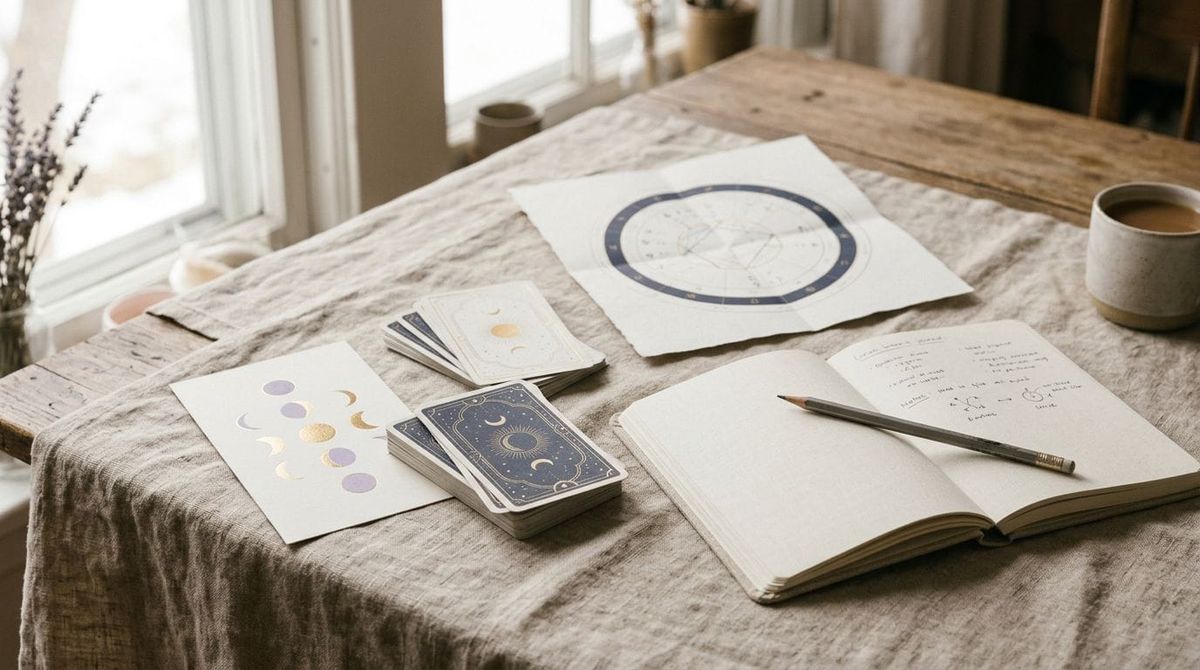
Astrology and tarot can both offer a symbolic language for reflection, but they work in different ways. Astrology begins with the sky and the structure of a birth chart. Tarot begins with a deck of illustrated cards and the questions you bring to it. You can study one practice on its own or let them support each other.
This beginner guide is the main starting point for Astrological Insights. It will help you choose a path, understand the essential concepts, build a steady learning practice, and find the right guide for your next question. You do not need to memorize every symbol before you begin.
Choose your starting point: Explore the complete astrology for beginners hub, begin with our tarot for beginners guide, or keep reading to see how the two practices differ and work together.
Astrology and tarot at a glance
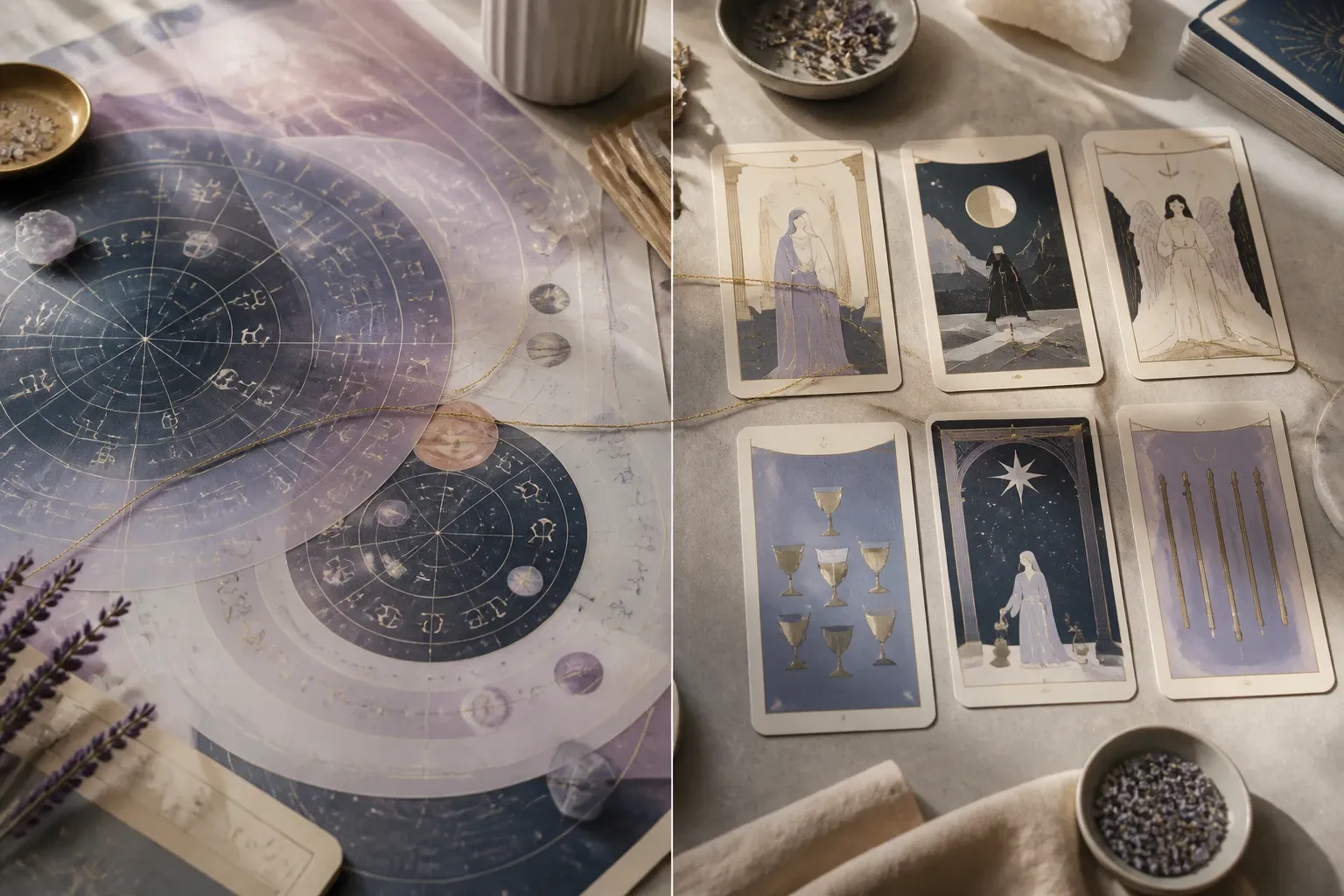
Astrology and tarot share an interest in patterns, archetypes, cycles, and meaning. Neither needs to be treated as a fixed prediction. Both are most useful when they help you slow down, notice context, and consider choices more carefully.
- Astrology interprets the positions and relationships of the Sun, Moon, planets, zodiac signs, houses, and aspects. A birth chart is calculated from a particular date, time, and place.
- Tarot uses a structured deck of 78 cards. The cards offer images, suits, numbers, and archetypes that can help you explore a question from several perspectives.
- Together, astrology can provide a broad symbolic context while tarot can focus attention on the question, feeling, or choice that is present now.
Astrology and tarot are spiritual or reflective practices, not scientific tools. They should not replace qualified medical, mental-health, legal, or financial advice.
Which practice should you learn first?
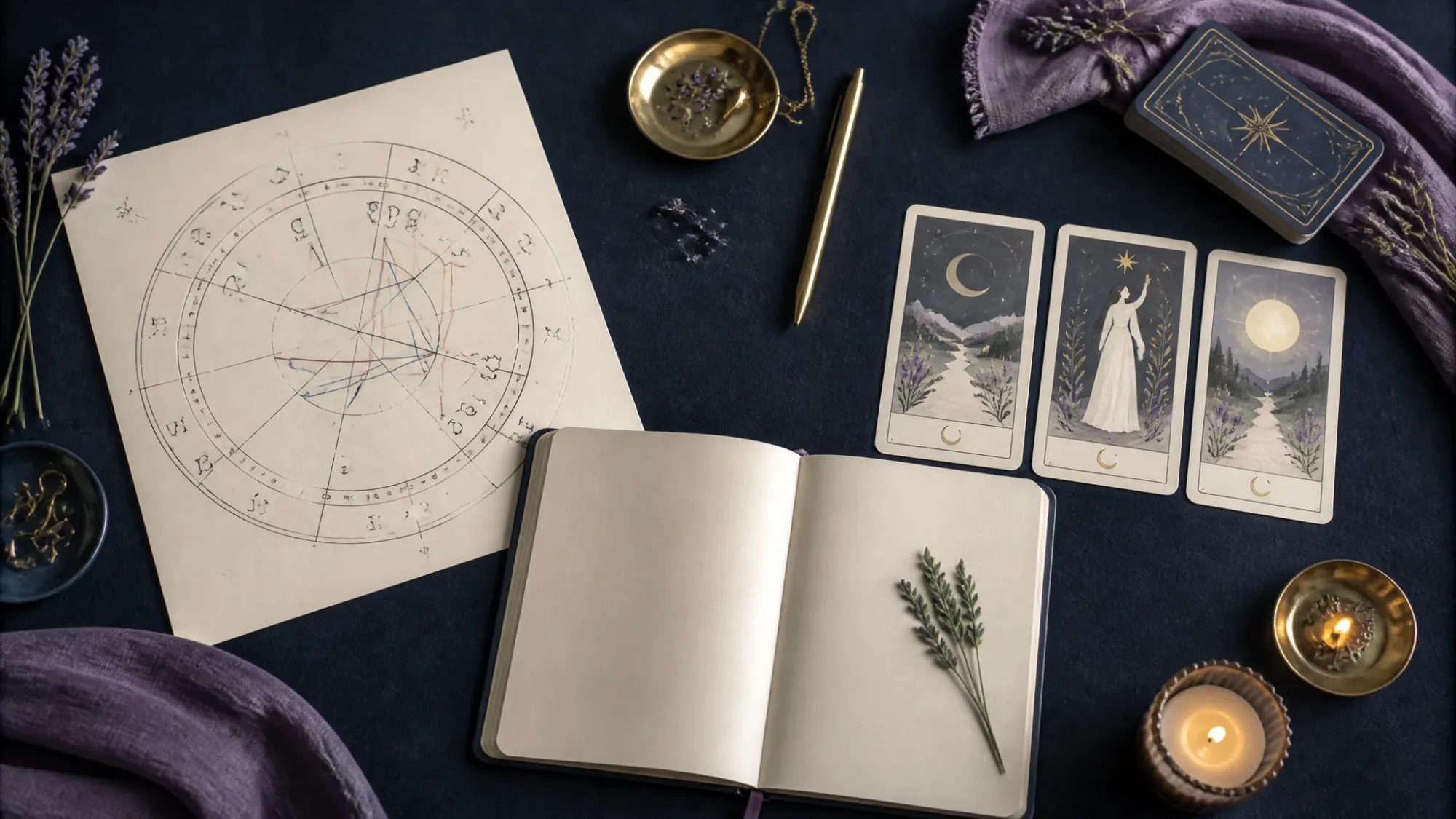
There is no correct order. Choose the practice that gives you enough curiosity to keep learning.
Start with astrology if you want to explore patterns over time
Astrology may suit you if you enjoy systems, cycles, detailed symbolism, or the idea of returning to one chart as your understanding develops. Your birth chart provides a stable map that you can study in layers: planets, signs, houses, angles, and aspects.
You will get the clearest chart with your birth date, birthplace, and exact birth time. If the time is unknown, you can still study many planetary signs, although the Rising sign and houses may be uncertain.
Start with tarot if you learn through images and questions
Tarot may suit you if you enjoy visual symbols, storytelling, journaling, or working with one question at a time. You can begin with a deck and a simple one-card draw. No birth details or complex calculation are required.
You do not need to be psychic to read tarot. Observation, context, practice, and thoughtful questions are more useful than trying to force a dramatic prediction.
How to begin learning astrology
A birth chart can look crowded at first. Instead of decoding every line, learn the chart in a dependable order.
- Create and orient yourself to the chart. Learn what the wheel, symbols, houses, and aspect lines represent. Our beginner’s natal chart guide walks through the layout.
- Begin with the Sun, Moon, and Rising sign. The Sun relates to identity and direction, the Moon to emotional needs, and the Rising sign to how you approach the world. Read more about Rising sign meaning and why birth time matters.
- Add the personal planets. Mercury, Venus, and Mars bring detail to communication, values, relationships, desire, and action.
- Learn the houses. Houses show where a planetary theme tends to appear in life. Use our guide to the twelve houses in astrology as a reference.
- Study the major aspects. Conjunctions, oppositions, squares, trines, and sextiles describe how planetary themes interact. Continue with Astrology Aspects Explained.
- Look for repeated themes. Repeated signs, elements, houses, or aspect patterns usually tell you more than one placement interpreted alone.
When you are ready to combine the pieces, follow the step-by-step birth chart reading guide. The goal is not to collect labels; it is to translate a pattern into clear, flexible language.
How to begin learning tarot
A standard tarot deck contains 22 Major Arcana cards and 56 Minor Arcana cards. You can learn the deck through structure and repeated practice rather than memorizing 78 separate definitions.
- Become familiar with your deck. Look through every card without testing yourself. Notice colors, expressions, landscapes, objects, and repeated symbols.
- Understand the two main sections. The Major Arcana often points to larger archetypal themes, while the Minor Arcana describes the texture of everyday experience. Read Major Arcana vs. Minor Arcana for a complete comparison.
- Learn the four suits. Wands, Cups, Swords, and Pentacles provide an organizing framework for action, emotion, thought, and material life. Explore the four tarot suits and their meanings.
- Start with a small spread. A one-card reflection or a focused three-card layout is easier to synthesize than a large spread. Try these easy tarot spreads for beginners.
- Ask an open, useful question. Questions beginning with “what,” “how,” or “where can I focus?” usually create more room for reflection than questions demanding certainty. Use our guide to asking better tarot questions.
- Write the story before checking a guidebook. Describe what you see and how the cards relate, then compare your interpretation with the deck’s reference material.
Astrology vs. tarot: the key differences
The practices overlap in symbolism, but their structures and uses are distinct.
- Source: astrology uses calculated celestial positions; tarot uses cards selected for a reading.
- Structure: an astrological chart has planets, signs, houses, angles, and aspects; a tarot deck has Major and Minor Arcana, four suits, court cards, and numbered cards.
- Starting information: natal astrology usually begins with birth data; tarot begins with a question, topic, or intention.
- Time: a birth chart remains the same, while tarot readings can be repeated for different questions and moments.
- Learning style: astrology often appeals to systematic learners; tarot often appeals to visual and narrative learners. Many people enjoy both.
- Use: astrology can reveal broad recurring themes and cycles; tarot can help focus a present conversation or journaling session.
These are differences in method, not a competition over which practice is “more accurate.” The value of either depends on how carefully, ethically, and reflectively it is used.
How astrology and tarot can work together
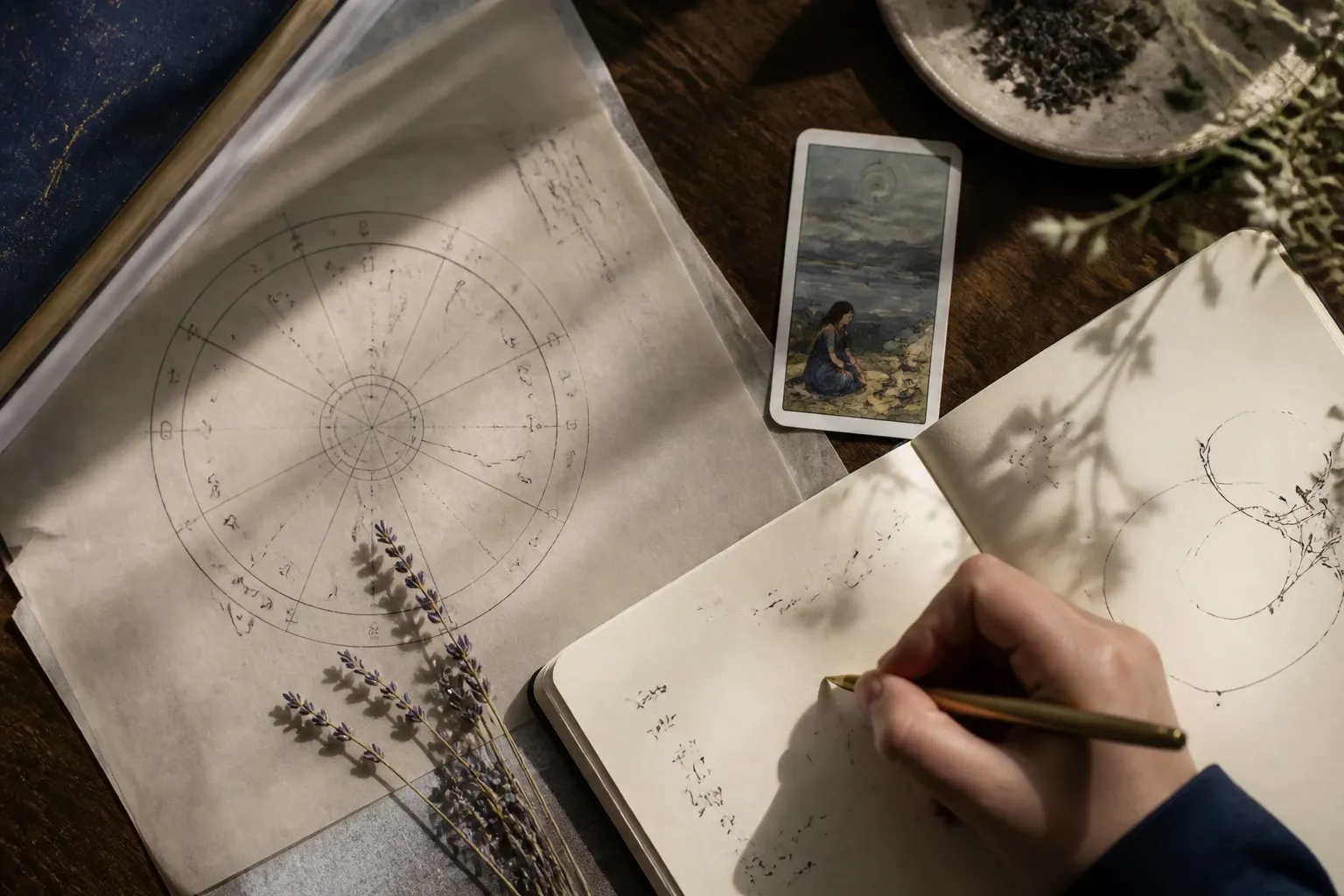
Combining the two does not require assigning a tarot card to every planet or zodiac sign. A simple approach is to let astrology establish context and tarot open a focused reflection within it.
A chart-theme reflection
Choose one birth-chart theme you are already studying, such as communication, boundaries, creativity, or belonging. Ask the tarot, “What would help me express this theme with more awareness?” Draw one to three cards and journal about the connection. The cards do not change the chart; they offer another lens.
A cycle check-in
If you are reflecting on a current astrological season, first write what you already know and how it is showing up in your life. Then ask a grounded tarot question such as, “Where is my attention most useful?” Avoid turning either system into a promise that a particular event must happen.
A decision journal
List the facts of a decision before bringing in astrology or tarot. Use the symbolic practice to uncover priorities, fears, or overlooked possibilities—not to hand away responsibility. Finish by writing one practical action you can take in the real world.
A simple 20-minute beginner practice
You can build skill without making spirituality a full-time project. Try this weekly routine:
- Settle for two minutes. Put away distractions and name the topic you want to explore.
- Study for five minutes. Read one chart placement, house, aspect, suit, number, or tarot card.
- Observe for five minutes. Describe the symbol in your own words before reaching for a fixed meaning.
- Reflect for five minutes. Connect the symbol to a real situation, feeling, choice, or pattern.
- Choose one action. End with something small and practical: have a conversation, write a boundary, rest, gather information, or return to the question later.
Date your notes. Over time, your journal becomes more valuable than a collection of memorized keywords because it shows how your understanding has changed.
Common beginner mistakes to avoid
- Trying to learn everything at once. Choose one layer and practice it until the structure feels familiar.
- Reading every symbol as literal. Astrology and tarot communicate through patterns, metaphors, and context.
- Treating difficult symbols as punishment. A challenging aspect or unsettling card can describe tension, effort, uncertainty, or a need for care—not inevitable harm.
- Asking the same question repeatedly. Repeated readings can increase anxiety rather than clarity. Pause, gather real-world information, and allow time for action.
- Ignoring consent. Avoid using either practice to make invasive claims about another person’s private motives or future.
- Replacing professional support. Use qualified experts for health, safety, legal, financial, or mental-health decisions.
Frequently asked questions
Is astrology easier to learn than tarot?
Neither is universally easier. Tarot has fewer calculations and can be started quickly with one card, while astrology provides a stable system that some structured learners prefer. Begin with the one that makes you want to practice.
Can I learn astrology without an exact birth time?
Yes, but with limits. Many planetary signs can still be read, while the Rising sign, Midheaven, and house placements may be uncertain. Do not present a guessed birth time as confirmed.
Do I need a special or gifted tarot deck?
No. Choose a deck with imagery you can see clearly and a guidebook you understand. Being able to study the cards consistently matters more than how the deck arrived.
Can tarot predict the future?
Tarot can help you explore present conditions, possibilities, and choices, but it should not be treated as a guarantee. Circumstances change, people make decisions, and uncertainty is part of life.
Can astrology and tarot be used together?
Yes. Keep each system’s structure clear: astrology can establish a broad theme, while tarot can provide a focused reflective prompt. You do not need to force a one-to-one correspondence between every card and placement.
Are astrology and tarot religious?
People use them within many spiritual, religious, secular, and creative contexts. You can approach them as personal symbolic practices without adopting beliefs that do not fit your values.
Choose your next beginner guide
Astrology learning path
- Astrology for Beginners — the complete hub for signs, planets, houses, aspects, and chart reading.
- How to Read a Birth Chart — understand the natal chart wheel and key placements.
- Rising Sign Meaning — learn how the Ascendant shapes the chart.
- The 12 Houses in Astrology — connect placements with areas of life.
- Astrology Aspects Explained — understand how planets interact.
Tarot learning path
- Tarot for Beginners — learn the deck, basic reading process, and first practices.
- Major Arcana vs. Minor Arcana — understand the tarot deck’s two main sections.
- Four Tarot Suits — learn Wands, Cups, Swords, and Pentacles.
- Easy Tarot Spreads for Beginners — practice with clear card positions.
- How to Ask Better Tarot Questions — turn vague or anxious questions into useful prompts.
Choose one guide, take one page of notes, and practice one idea before moving on. Depth grows through repetition, not through rushing.
This content is for educational and reflective purposes only. Astrology and tarot should not replace qualified medical, mental-health, legal, or financial advice.
For new guides and reflective prompts, visit the free Astrological Insights newsletter.