
What Does Your Rising Sign Mean? A Beginner’s Guide
A beginner-friendly guide to Rising sign meaning, Ascendant calculation, the 12 Rising signs, chart rulers, houses, and birth-time accuracy.
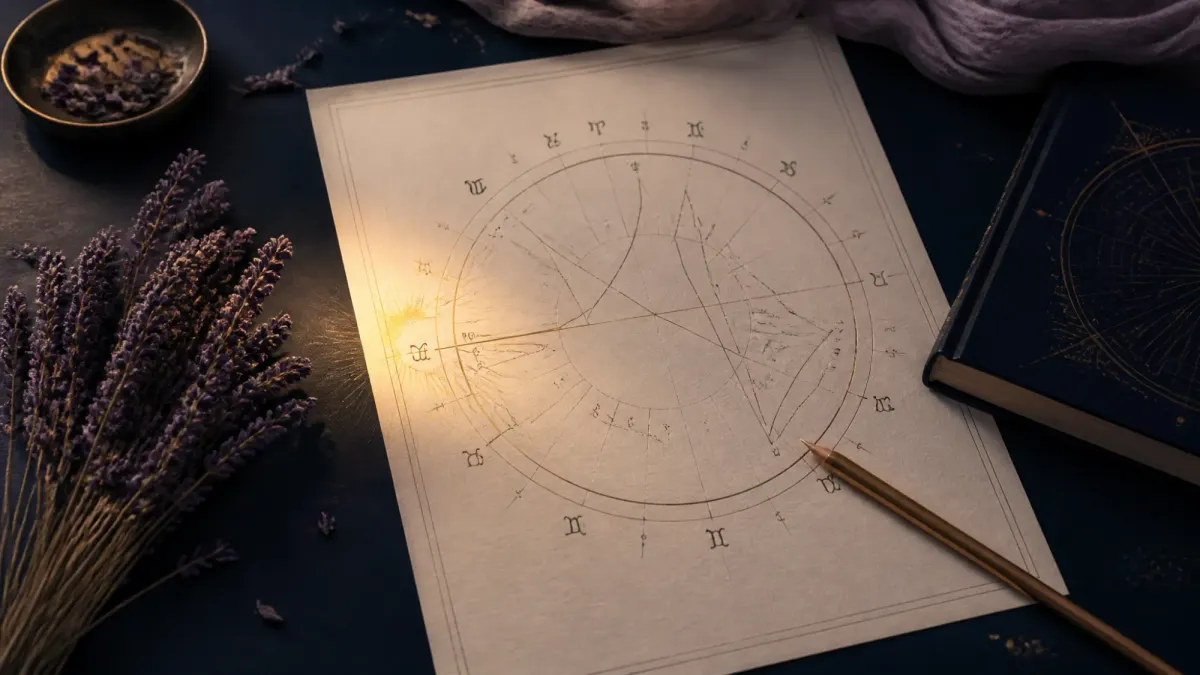
Your Rising sign, also called your Ascendant, is the zodiac sign that was rising on the eastern horizon at the exact moment and place of your birth. In astrology, it describes how you meet the world, the qualities you show first, and the starting point of your entire birth chart.
People often reduce the Rising sign to “the mask you wear.” That can be misleading. Your Ascendant is less like a disguise and more like an instinctive orientation: how you enter unfamiliar situations, respond to your surroundings, and begin new experiences.
What is a Rising sign?
The Rising sign is the sign on the cusp of the first house in a natal chart. The Ascendant is technically an exact degree, while “Rising sign” refers to the zodiac sign containing that degree. In everyday astrology, the two terms are usually used interchangeably.
Because the first house is associated with selfhood, embodiment, and personal approach, astrologers look to the Ascendant for clues about your outward style and the way you engage with life. It also determines the order of the remaining houses, giving every planet in your chart a particular area of life in which to operate.
How is your Rising sign calculated?
Your Ascendant depends on three pieces of birth information:
- Your birth date
- Your exact birth time
- Your birth location
As Earth rotates, different zodiac signs appear on the eastern horizon. A new sign rises roughly every two hours, but the timing is not perfectly even and can vary by latitude. That is why two people born on the same day can have different Rising signs—and why even a small birth-time difference can sometimes change the result.
Use a reliable birth-chart calculator and check your birth certificate or another recorded source whenever possible. If your time is approximate, treat the Rising sign and house placements as uncertain. It is better to acknowledge an unknown birth time than to adjust it until the chart seems to fit.
If you are new to chart calculation, start with our beginner’s guide to reading a birth chart.
Which Astrology System Does This Guide Use?
This guide uses Tropical, or Western, astrology for Rising sign calculations and chart interpretation. The Tropical zodiac anchors the signs to the seasonal cycle, beginning Aries at the March equinox, rather than matching zodiac signs directly to the present-day constellations.
A Sidereal or Vedic chart may show a different Ascendant because it uses a different zodiac reference. Neither result should be mixed into the other system mid-reading. When comparing charts or calculators, check that they use the same zodiac system and the same birth data.
Can You Find Your Rising Sign From a Sun-Sign and Birth-Time Table?
A traditional Ascendant table may ask you to locate your Sun sign in one row and your birth time in a column, then read the sign where they meet. If you use one, follow that table’s own instructions carefully, including whether it expects local civil time or Standard Time. Treat the result as a rough estimate, not a confirmed Ascendant.
Your Sun sign and clock time are not enough to calculate the Ascendant precisely. The result also depends on the full birth date, birthplace, latitude, longitude, and the historical time-zone rules in effect. Tables usually simplify some of these variables, so two people with the same Sun sign and birth time can still have different Rising signs.
Why Time of Day Matters
Earth’s rotation changes the sign on the eastern horizon throughout the day. A birth near sunrise may place the Ascendant close to the Sun’s sign, but the sequence does not advance in perfectly equal two-hour blocks. Some signs rise faster or slower depending on latitude, so labels such as “morning,” “afternoon,” or “evening” can narrow possibilities but cannot establish the answer.
Standard Time, Daylight Saving Time, and War Time
Do not automatically subtract one hour from your recorded birth time. A modern chart calculator should receive the civil time written in the record, along with the exact date and birthplace, so it can apply the correct historical time zone and daylight-saving rule. Manual adjustment is appropriate only when a specific printed table explicitly requires Standard Time. Historical rules—including War Time and regional exceptions—were not always a simple one-hour shift.
Why a Fully Calculated Natal Chart Is More Reliable
A reputable chart calculator or professionally cast natal chart converts the recorded time correctly, accounts for the birthplace, and calculates the exact degree where the ecliptic meets the eastern horizon. Professional help can be useful when records conflict or the Ascendant is close to a sign boundary, although birth-time rectification remains interpretive and cannot turn uncertain data into certainty.
What does your Rising sign describe?
Astrologers commonly associate the Ascendant with:
- First impressions: the qualities other people may notice before they know you well.
- Your instinctive approach: how you enter new rooms, relationships, tasks, or phases of life.
- Personal style and presence: the pace, tone, or manner through which you express yourself.
- The first house: themes of identity, self-presentation, agency, and embodied experience.
- Your chart ruler: the planet connected with your Rising sign, which becomes an important guide for interpreting the chart.
These are symbolic themes, not a fixed personality test. Your Sun, Moon, planets, aspects, culture, experiences, and choices all add context. A Rising sign should help you ask better questions about your patterns—not box you into a label.
The 12 Rising signs at a glance
Each Ascendant tends to approach new experiences through the style of its zodiac sign. These short descriptions are starting points rather than complete readings.
- Aries Rising: direct, active, quick to initiate, and often most comfortable learning by doing.
- Taurus Rising: steady, observant, sensory, and inclined to build trust or momentum gradually.
- Gemini Rising: curious, adaptable, verbal, and likely to meet the world by asking questions.
- Cancer Rising: receptive, protective, intuitive, and attentive to emotional atmosphere.
- Leo Rising: warm, expressive, creative, and inclined to approach life with visible presence.
- Virgo Rising: discerning, practical, detail-aware, and motivated to understand how things work.
- Libra Rising: relational, diplomatic, aesthetically aware, and attentive to balance and response.
- Scorpio Rising: private, perceptive, intense, and likely to assess a situation before revealing much.
- Sagittarius Rising: open, exploratory, candid, and drawn toward meaning, movement, or possibility.
- Capricorn Rising: measured, responsible, composed, and inclined to approach life with a long view.
- Aquarius Rising: independent, conceptual, unconventional, and alert to systems or group dynamics.
- Pisces Rising: sensitive, imaginative, fluid, and highly responsive to mood and environment.
For a fuller interpretation, look beyond the sign alone. Planets near the Ascendant, aspects to it, and the condition of its ruling planet can noticeably change how it is expressed.
Why your Rising sign sets the houses
The Ascendant begins the first house, and the other houses follow around the wheel of the chart. This links your Rising sign to the framework astrologers use for topics such as money, communication, home, creativity, relationships, work, community, and vocation.
For example, two people may both have Venus in Gemini, but if Venus falls in different houses, its themes are directed toward different areas of life. This is one reason an exact birth time adds so much detail to a natal chart. Review the 12 houses in astrology to see how the sequence works.
How to find your chart ruler
Your chart ruler is the planet that rules your Rising sign. Its sign, house, and major aspects show where the Ascendant’s energy is directed and what may support—or complicate—your usual way of navigating life.
- Aries Rising: Mars
- Taurus Rising: Venus
- Gemini Rising: Mercury
- Cancer Rising: Moon
- Leo Rising: Sun
- Virgo Rising: Mercury
- Libra Rising: Venus
- Scorpio Rising: Mars (traditional) and Pluto (modern)
- Sagittarius Rising: Jupiter
- Capricorn Rising: Saturn
- Aquarius Rising: Saturn (traditional) and Uranus (modern)
- Pisces Rising: Jupiter (traditional) and Neptune (modern)
Suppose you have Gemini Rising. Mercury is your chart ruler. If Mercury is in the fourth house, themes of home, family, privacy, or inner foundations may become especially relevant to how you orient yourself. The chart ruler adds a useful thread; it does not replace the Sun, Moon, or the rest of the chart.
Rising sign vs. Sun sign vs. Moon sign

These three placements describe different parts of the chart:
- Sun sign: associated with identity, vitality, purpose, and the qualities you are learning to express consciously.
- Moon sign: associated with emotional needs, habits, comfort, memory, and instinctive responses.
- Rising sign: associated with orientation, first impressions, personal approach, and the structure of the houses.
You may strongly identify with all three, or one may feel more obvious at a particular stage of life. If your Sun and Rising signs are different, that is not a contradiction. It simply means your core vitality and your way of meeting the world use different symbolic styles.
How to interpret your Rising sign step by step
- Confirm the birth data. Check the accuracy of the date, time, and place used to calculate your chart.
- Study the sign. Note its element, modality, and common approach to action or relationship.
- Look at the first house. Planets close to the Ascendant can become highly visible in your manner or experience of self.
- Find the chart ruler. Locate its sign and house, then check its major aspects.
- Compare the symbols with experience. Notice what resonates, what does not, and what becomes clearer over time without forcing a perfect match.
Reading these layers together produces a more useful interpretation than relying on a one-line Rising-sign description.
What if you do not know your birth time?
Without an accurate birth time, you usually cannot confirm the Ascendant or the house placements. You can still explore planets by sign, although the Moon may also require care on days when it changed signs.
A Sun-sign and time-of-day table may narrow the possibilities, but it cannot establish your actual Rising sign. If you have an approximate time range, enter the earliest and latest plausible times into the same reliable calculator and note whether the Ascendant changes.
If a calculated Rising sign does not seem to fit, first recheck the recorded time, a.m. or p.m., birthplace, historical time zone, daylight-saving setting, and whether the calculator uses Tropical or Sidereal astrology. Do not choose a neighboring sign only because its short description feels more familiar. Planets near the Ascendant, aspects to it, the chart ruler, culture, and lived experience can all change how the placement is expressed.
Professional birth-time rectification may help when no reliable record exists, but it relies on interpretive judgment and should be presented as an informed hypothesis rather than certainty.
Frequently asked questions
Is the Ascendant the same as the Rising sign?
Yes, in most astrology writing the terms are used interchangeably. More precisely, the Ascendant is the degree on the eastern horizon, while the Rising sign is the zodiac sign containing that degree.
How often does the Rising sign change?
On average, a different sign rises about every two hours. The exact timing varies by date and location, so a chart calculator needs precise birth information.
Can your Rising sign change?
Your natal Rising sign does not change; it belongs to the birth chart for one moment and place. Some astrologers work with timing techniques that move chart points symbolically, but those do not replace the natal Ascendant.
Does your Rising sign affect your appearance?
Some astrological traditions connect the first house and Ascendant with physical presence. It is more grounded to treat appearance descriptions as broad symbolism rather than reliable rules about facial features or body type.
Is the Rising sign more important than the Sun sign?
Neither placement needs to “win.” The Rising sign sets the houses and points to a chart ruler, while the Sun describes a different set of themes. A whole-chart reading considers how they work together.
A grounded way to use your Rising sign
Astrology is a symbolic and reflective practice, not a scientific method of personality measurement or prediction. Use your Ascendant as a prompt for self-inquiry: How do you enter unfamiliar situations? What do people notice first? Where does your chart ruler direct attention?
Explore the astrology learning hub or continue with Astrology for Beginners to connect signs, planets, houses, and aspects.
Join the free weekly newsletter for one practical astrology note, one tarot reflection prompt, and the newest beginner guide.
Astrological Insights offers educational and reflective content. It cannot replace medical, legal, financial, mental-health, or other professional advice.