
How to Read a Birth Chart: A Beginner’s Natal Chart Guide
Learn how to read a birth chart step by step: find your Big Three, understand planets, signs, houses, and aspects, then combine the patterns.
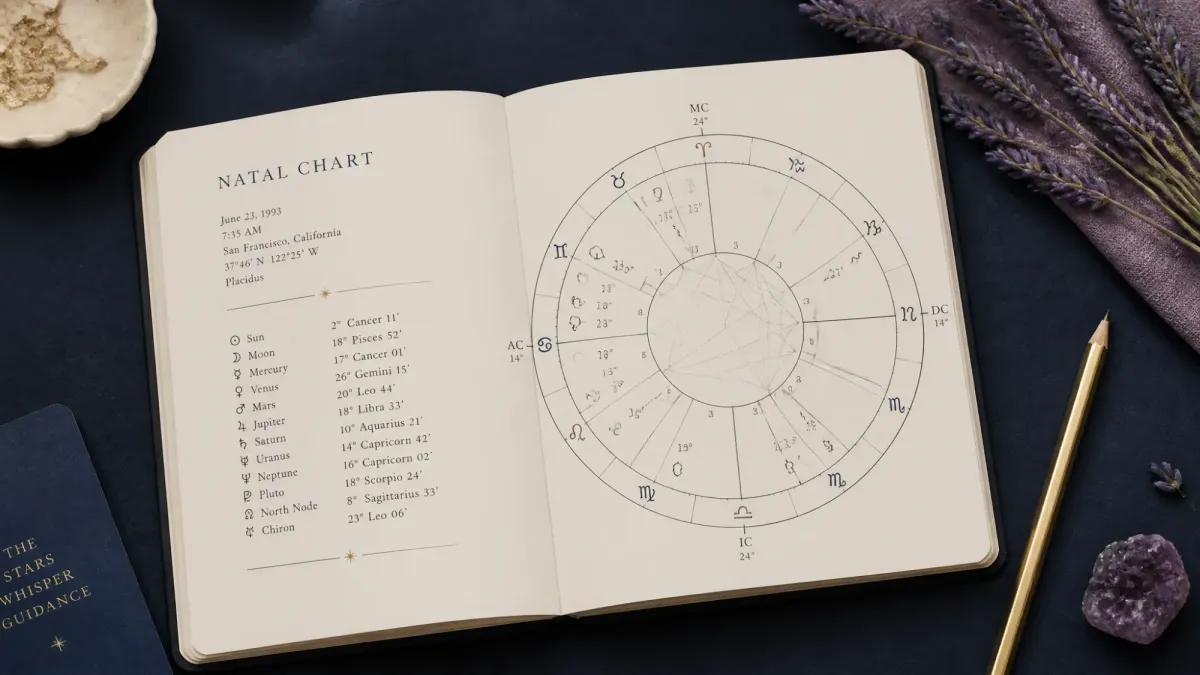
Learning how to read a birth chart becomes much easier when you stop treating it as a list of separate personality traits. A birth chart—also called a natal chart—is a map of the sky for a specific birth time and place. It shows the zodiac positions of the Sun, Moon, planets, and key angles across twelve houses.
Quick answer: Start with accurate birth data, find the Sun, Moon, and Rising signs, then read each planet as what, its sign as how, and its house as where. Add the major aspects and finish by looking for two or three repeating themes.
What does a birth chart show?
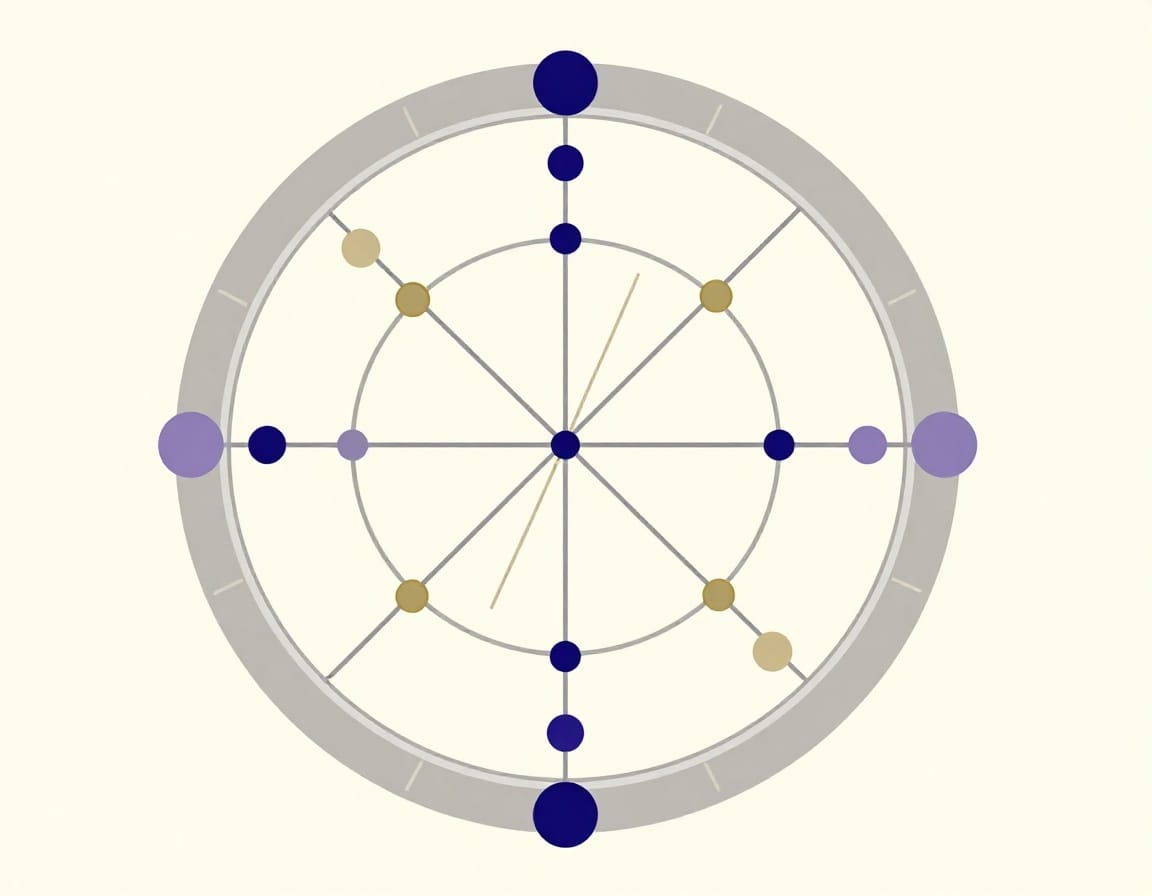
A standard Western birth chart looks like a circle divided into twelve sections. Each layer answers a different question:
- Planets describe the function or drive involved—the what.
- Zodiac signs describe how that function tends to express itself—the how.
- Houses connect the placement with an area of life—the where.
- Aspects show angular relationships between planets and describe how different parts of the chart interact.
The birth chart is best used as a symbolic tool for reflection. It does not lock you into a fixed personality or predict one unavoidable future.
Scientific Sky Diagrams vs. Astrological Birth Charts
A scientific sky diagram and an astrological birth chart can use some of the same planetary position data, but they are designed for different purposes. Astronomy diagrams model the physical locations and motions of celestial objects. Depending on the question, they may use a Sun-centered view, an Earth-centered observing view, or another coordinate system.
A natal chart is an Earth-centered map for one time and place. It projects the Sun, Moon, planets, and key angles onto the zodiac and organizes them into houses and aspects. This observer-based layout does not claim that Earth is physically at the centre of the solar system; it shows how the sky appeared from the birthplace.
The planetary calculations come from astronomy, while the meanings assigned to signs, houses, and aspects belong to astrology’s symbolic tradition. Reading a birth chart is therefore an interpretive practice, not the same thing as a scientific model or test.
What you need to calculate a birth chart
- Your full birth date.
- Your exact birth time from a reliable record, when possible.
- Your birth city and country.
- A birth chart calculator that shows signs, houses, degrees, and aspects.
If you do not know your exact birth time, you can still explore many planetary sign placements. However, your Rising sign and house placements may be uncertain. The Moon may also need verification if it changed signs on your birth date.
How to read a birth chart step by step
1. Orient yourself to the chart wheel
Before interpreting anything, find the house numbers, zodiac symbols, planet symbols, and aspect lines. In many Western chart layouts, the Ascendant appears on the left side of the wheel and the Midheaven appears near the top, but always check the calculator’s legend because layouts can vary.
Notice which signs sit on the house cusps and whether several planets gather in one part of the chart. This first scan gives you a map before you begin assigning meaning.
2. Begin with the Big Three
The Sun, Moon, and Rising sign create a useful starting framework. Read each placement separately, then notice where they support or contrast with one another.
- Sun sign: identity, vitality, and the qualities you are learning to develop.
- Moon sign: emotional needs, habits, and instinctive responses.
- Rising sign or Ascendant: your orientation to life, outward approach, and the beginning of the house system.
Next, note their elements—fire, earth, air, or water—and modalities—cardinal, fixed, or mutable. Repetition suggests emphasis. Contrast may point to different needs that require balance rather than a contradiction that must be “fixed.”
3. Read the personal planets
Add Mercury, Venus, and Mars before moving to the slower-moving planets. These placements describe familiar parts of everyday experience:
- Mercury: thinking, learning, and communication.
- Venus: values, attraction, pleasure, and connection.
- Mars: action, desire, motivation, and assertion.
For each planet, write down its sign and house. Avoid reducing a placement to one adjective; ask what the planet is trying to do, how the sign shapes its style, and where the house makes that pattern most visible.
4. Combine planets, signs, and houses
Use this simple sentence formula:
Planet = what. Sign = how. House = where.
For example, Mercury represents communication. Mercury in Taurus may communicate in a steady, practical, deliberate way. In the third house, that style may become especially noticeable in learning, writing, everyday conversations, or relationships with the local environment.
This is a starting interpretation, not a verdict. Aspects to Mercury and the rest of the chart can reinforce, soften, or complicate the theme.
5. Add the twelve houses
Houses connect planetary symbolism with areas of life such as identity, resources, communication, home, creativity, work, relationships, shared resources, belief, vocation, community, and retreat. Read The 12 Houses in Astrology for a beginner-friendly tour of the full sequence.
- First house: identity, embodiment, self-presentation, and how you begin.
- Second house: values, money, possessions, resources, and security.
- Third house: communication, learning, siblings, and the local environment.
- Fourth house: home, family, ancestry, privacy, and emotional foundations.
- Fifth house: creativity, pleasure, romance, play, and self-expression.
- Sixth house: daily routines, work, service, habits, and wellbeing.
- Seventh house: partnerships, commitments, and meaningful one-to-one relationships.
- Eighth house: shared resources, intimacy, trust, loss, and transformation.
- Ninth house: higher learning, travel, philosophy, belief, and the search for meaning.
- Tenth house: vocation, public life, achievement, responsibility, and reputation.
- Eleventh house: friendships, groups, community, collaboration, and future hopes.
- Twelfth house: rest, retreat, endings, the unconscious, and spiritual reflection.
An empty house does not mean that area of life is absent or doomed. It simply means no natal planet occupies that house. You can still study the sign on its cusp and the planet that rules that sign.
6. Look at the major aspects
Aspects are measured angles between chart points. Begin with the five major aspects instead of trying to interpret every line at once:
- Conjunction: two functions combine or intensify one another.
- Opposition: two ends of a polarity seek awareness and balance.
- Square: friction can create pressure, effort, and growth.
- Trine: energies tend to cooperate or flow with ease.
- Sextile: supportive potential often develops through participation and choice.
Tight aspects involving the Sun, Moon, personal planets, Ascendant, or Midheaven often stand out first. Treat “easy” and “challenging” as descriptions of dynamics, not promises of good or bad outcomes.
7. Find repeating patterns and synthesize
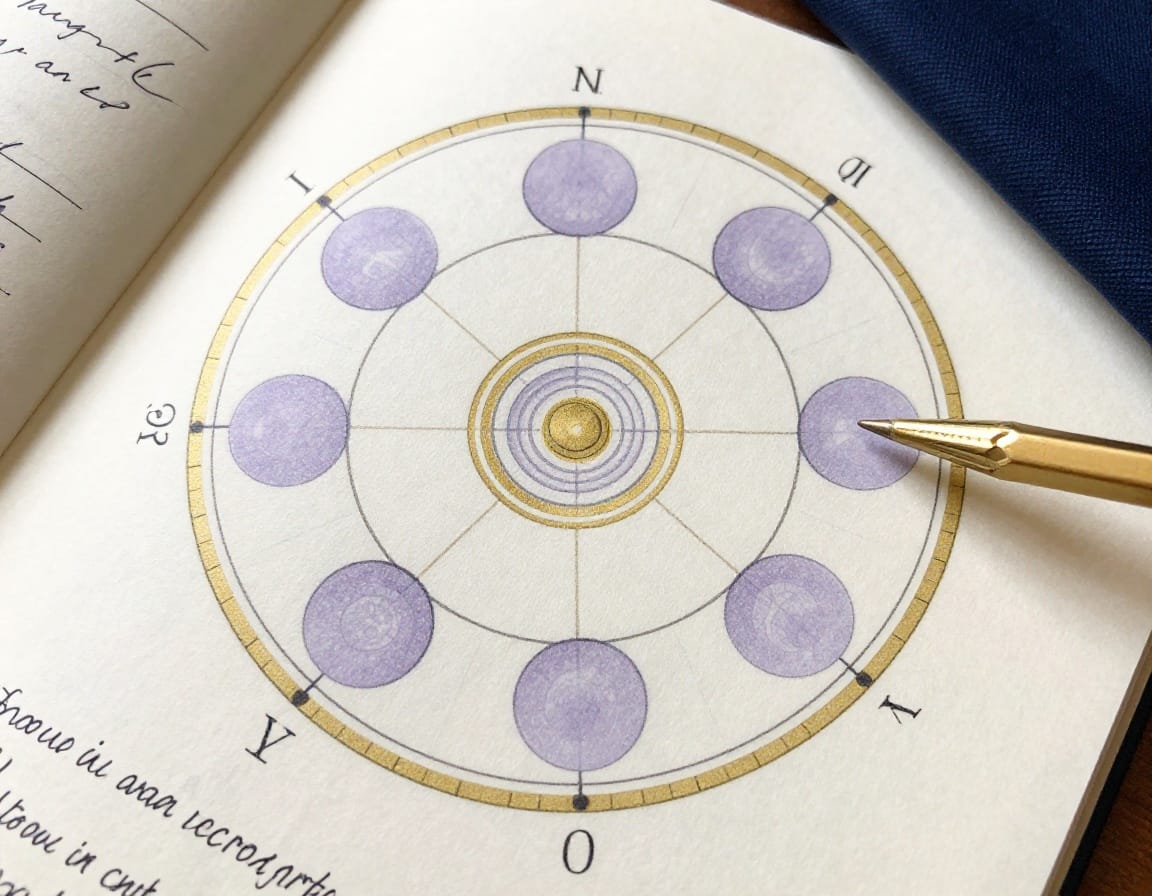
A useful chart reading ends with synthesis. Three related signals usually matter more than one isolated placement. Look for:
- Repeated elements or modalities.
- Several planets in one sign or house.
- A planet connected to several major aspects.
- The ruler of the Rising sign and where it appears.
- Connections among the Sun, Moon, and Ascendant.
Write a short summary using only two or three themes. A balanced synthesis might sound like: “This chart repeats earth and fixed-sign symbolism, suggesting a steady, practical approach. Strong Mercury connections add a need to process experience through learning and conversation. Tension involving the Moon suggests that emotional needs may require more conscious space.”
What Is Predictive Astrology?
Predictive astrology studies timing techniques that compare a natal chart with changing planetary cycles. The most familiar technique is the transit: the current position of a planet is compared with the planets, houses, and angles in the birth chart.
Astrologers often begin with transits to the Sun, Moon, Ascendant, chart ruler, Mercury, Venus, and Mars, then consider slower planets and major aspects. A transit may highlight a theme without dictating one event. Venus can draw attention to relationships, values, pleasure, or money; Mars may emphasize action, assertion, or frustration; Saturn may bring questions of structure, boundaries, responsibility, and commitment.
Other timing methods include secondary progressions, solar returns, and planetary return charts. Each uses a different symbolic framework, so beginners usually gain more clarity by learning one method at a time and relating it back to the natal chart.
Predictive astrology should not be used to surrender personal judgment or promise fixed outcomes. Think of timing techniques as a way to reflect on the season you are in: they can suggest themes, pressures, and opportunities, while your choices and circumstances still matter.
What Happens During a Saturn Return?
A Saturn return occurs when transiting Saturn comes back to the zodiac position it occupied at your birth. Saturn takes about 29.5 years to orbit the Sun, so the first return is commonly experienced in the late twenties, with later returns roughly three decades apart.
Astrologers associate this cycle with reviewing responsibility, boundaries, commitments, and the structures supporting your life. It may coincide with decisions about work, relationships, home, or long-term direction, but no particular event is guaranteed. The deeper theme is often a clearer understanding of what you are prepared to sustain.
A Saturn return can feel demanding when an old pattern or commitment no longer fits, yet it can also support maturity and self-respect. Use the symbolism as a prompt to clarify priorities and build deliberately, not as a warning that hardship is inevitable.
A beginner birth chart reading order
- Confirm the birth date, time, and location.
- Identify the Sun, Moon, and Rising signs.
- Note their signs, houses, elements, and modalities.
- Add Mercury, Venus, and Mars.
- Read each placement as planet + sign + house.
- Check the major aspects.
- Identify two or three repeating themes.
- Write a brief, flexible synthesis.
Common birth chart mistakes beginners make
- Reading placements in isolation: one symbol rarely tells the whole story.
- Treating interpretations as fixed labels: use them as reflective questions, not limits.
- Assuming empty houses are missing life areas: every house remains part of the chart.
- Starting with minor details: learn the Big Three and personal planets before asteroids or advanced techniques.
- Ignoring uncertain birth data: an inaccurate time can change the Rising sign, houses, and angles.
- Trying to interpret everything at once: a repeatable reading order produces a clearer story.
Birth chart questions beginners often ask
Are a birth chart and a natal chart the same thing?
Yes. In modern astrology, “birth chart” and “natal chart” usually describe the same chart calculated for your birth date, time, and place.
Can I read a birth chart without a birth time?
You can still examine many planetary sign placements, but the Rising sign and houses may be unreliable. Check whether the Moon changed signs that day before assuming its placement.
What should I read first in my birth chart?
Start with the Sun, Moon, and Rising signs. Then add Mercury, Venus, Mars, their houses, and the major aspects. Save smaller details for later.
What do the lines in a birth chart mean?
The lines usually represent aspects—the angular relationships between planets. Their colours and styles vary by calculator, so use the chart legend before interpreting them.
Can I interpret my own natal chart?
Yes. Keep your first reading simple, write down observations before searching for interpretations, and return to the chart over time. Self-interpretation is often most useful when it encourages curiosity rather than certainty.
A grounded approach to astrology
Astrology is a symbolic and reflective practice, not a scientific method of prediction. Use a birth chart to support self-inquiry and personal judgment rather than fixed claims about personality, compatibility, health, or future events. Astrology cannot replace medical, legal, financial, mental-health, or other professional advice.
Keep learning with Astrological Insights
Build your foundation with Astrology for Beginners, then explore the astrology learning hub for guides to signs, planets, houses, and aspects.
Join the free weekly newsletter for one practical astrology note, one tarot reflection prompt, and the newest beginner guide.