
3 Easy Tarot Spreads for Beginners: Card Positions & Questions
Learn three easy tarot spreads for beginners, with clear card positions, sample questions, and grounded tips for reflective readings.
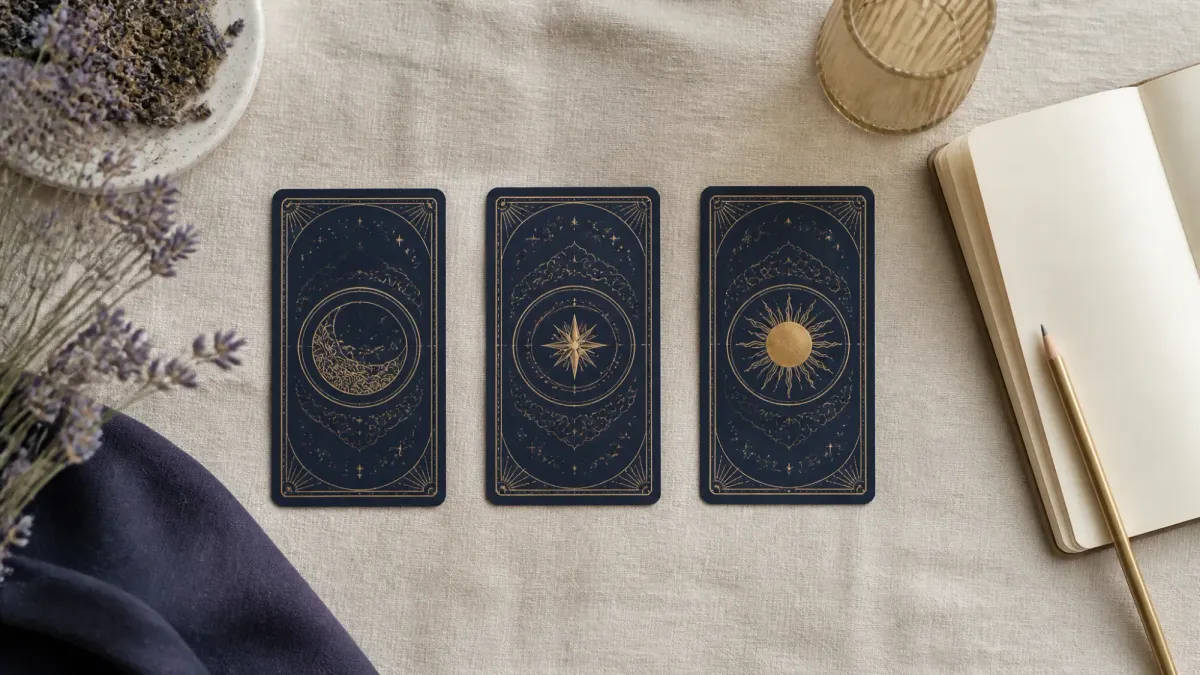
Easy tarot spreads for beginners use only one to three cards and give every card a clear role. This makes it easier to learn individual card meanings, notice connections, and reflect on a question without becoming overwhelmed.
A tarot spread is simply the arrangement of cards in a reading. Each position represents a particular part of the question, such as the situation, a different perspective, or a possible next step.
The three beginner tarot spreads below are designed for reflection and practical thinking—not guaranteed predictions.
The best tarot spreads for beginners
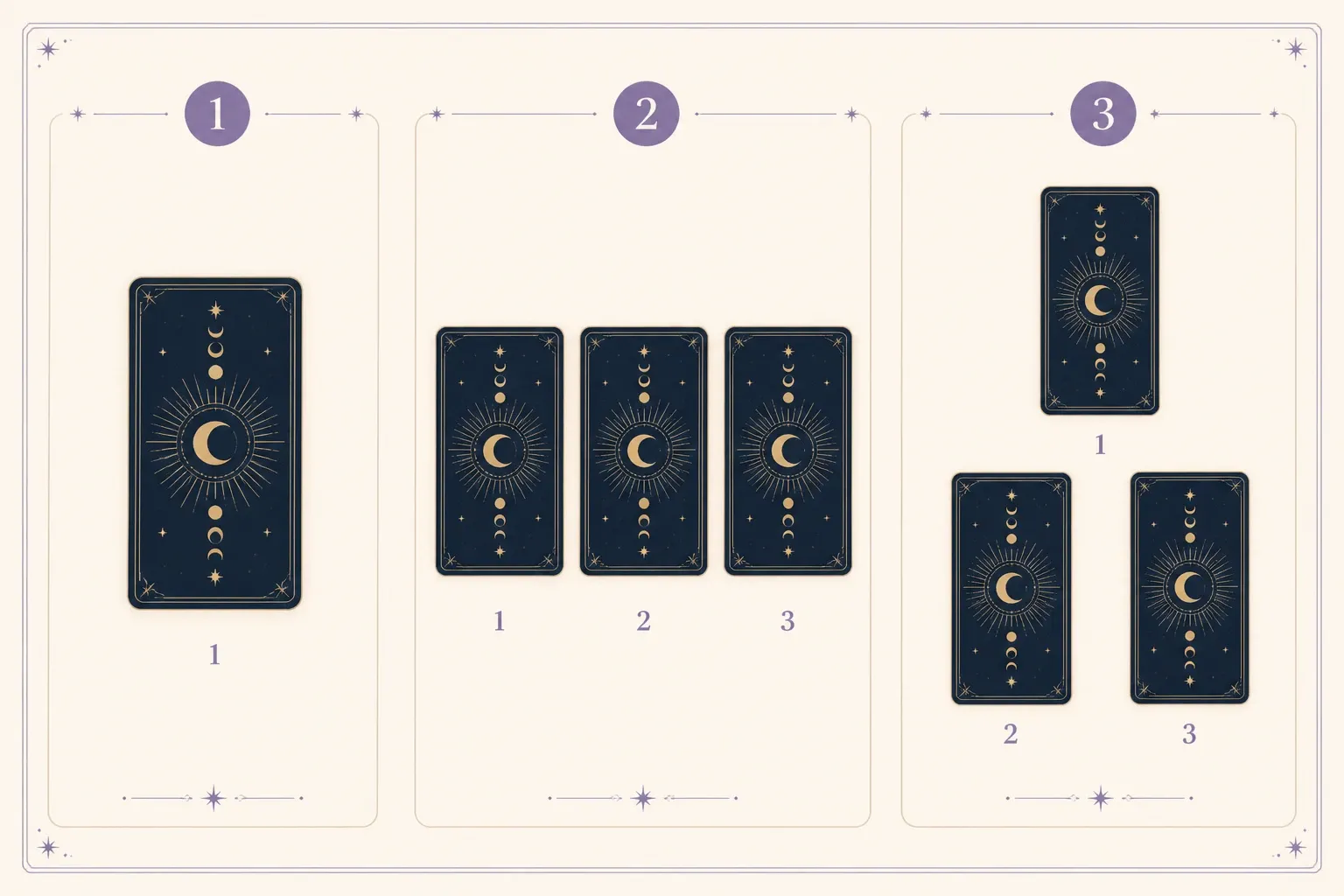
If you are just starting, try:
- A one-card reflection for daily focus or journaling.
- A situation, perspective, next-step spread for understanding a current concern.
- A two-choice spread for exploring values and trade-offs.
Start with the smallest spread that suits your question. More cards do not always produce a clearer reading.
Before you begin
- Choose one clear, open question.
- Write your question and the meaning of each card position in a journal.
- Decide whether you will use reversed cards before you shuffle.
- Shuffle while holding the question in mind.
- Place the cards in their assigned positions from left to right.
- Read each card separately before looking for patterns.
- End with one insight or grounded next step.
Spread 1: One-card reflection
Best for: Daily reflection, journaling, learning card meanings, or bringing attention to one part of a situation.
A one-card tarot spread is the simplest place to begin. Because there is only one card, you can spend more time observing its imagery and connecting it to your question.
Try asking:
- What deserves my attention today?
- What strength can I bring to this situation?
- What perspective might be useful right now?
- What is one grounded next step?
- What could I learn from this experience?
How to read the one-card spread
Describe what you see before checking the guidebook. Notice the card’s central action, mood, direction, colours, and one symbol that catches your attention.
Next, connect that observation to your question. Finally, compare your first impression with the card’s traditional meaning.
Write one sentence that begins:
“In relation to my question, this card invites me to consider…”
This keeps the reading focused on reflection rather than prediction.
Spread 2: Situation, perspective, next step
Best for: A challenge, emotional check-in, creative block, relationship question, or practical concern.
Place three cards in a horizontal row and read them from left to right.
- Card 1 — Situation: What is most relevant about the current context?
- Card 2 — Perspective: What might I be overlooking or framing too narrowly?
- Card 3 — Next step: What response could support me now?
Read each card in its assigned position first. Then consider how the cards relate to one another.
Do the images appear to move toward or away from each other? Is one suit repeated? Does one card introduce a noticeably different mood? These patterns can help you turn three separate meanings into one coherent reflection.
Finish by summarizing the reading in two or three sentences:
- What seems most important?
- What perspective has changed?
- What action or reflection remains within my control?
Spread 3: Comparing two choices
Best for: Exploring two possible directions without asking the cards to make the decision for you.
This spread does not declare one option “right” and the other “wrong.” Instead, it can help you examine what matters, what each possibility may teach you, and what additional information you still need.
- Card 1 — What matters most: Which value, responsibility, or need should remain central?
- Card 2 — Exploring option A: What could I learn or encounter by exploring this direction?
- Card 3 — Exploring option B: What could I learn or encounter by exploring the other direction?
Compare the second and third cards without treating either as a fixed outcome. Look for differences in pace, emotional tone, effort, uncertainty, and alignment with the value shown in the first card.
Then return to practical information. What facts do you need? Who might be affected? Is professional guidance appropriate? Tarot can support reflection, but the decision remains yours.
How to interpret a simple tarot spread
Use this five-step process with any beginner spread:
- Observe: Describe the card before interpreting it.
- Apply the position: Ask what the card means in its specific role.
- Compare: Look for contrasts, repetitions, or visual relationships.
- Summarize: Explain the spread in two or three plain sentences.
- Ground the reading: Choose one question to journal about or one realistic action to consider.
You do not need to find a dramatic message. A useful reading may simply help you name a feeling, notice an assumption, or approach a situation differently.
Common beginner tarot spread mistakes
- Pulling extra clarifying cards until the original question becomes lost.
- Choosing card positions only after seeing the cards.
- Treating a challenging image as a guaranteed negative event.
- Asking the same question repeatedly to obtain a preferred answer.
- Reading every card separately without considering their relationship.
- Ignoring facts, responsibilities, or practical information outside the reading.
Frequently asked questions
How many tarot cards should a beginner use?
Start with one to three cards. A one-card spread helps you learn individual meanings, while a three-card spread introduces relationships without creating too much complexity.
What is the easiest tarot spread to learn?
The one-card reflection is the easiest. If one card feels too open-ended, use a three-card spread with clearly defined positions.
Do beginners need to read reversed tarot cards?
No. You can read every card upright while you learn the deck. If you decide to use reversals later, choose that approach before shuffling and apply it consistently.
Can tarot cards make a decision for me?
Tarot can help you explore feelings, assumptions, values, and possible considerations. It cannot replace your judgment, factual research, or qualified professional advice.
A grounded approach to tarot
Tarot is a reflective practice, not a source of certainty. Use the cards alongside your judgment, context, lived experience, and reliable information.
A tarot reading cannot replace medical, legal, financial, mental-health, or other professional advice.
Keep learning with Astrological Insights
Explore the tarot learning hub or continue with Tarot for Beginners for a clear path through the cards, spreads, and reflective reading.
Join the free weekly newsletter for one practical astrology note, one tarot reflection prompt, and the newest beginner guide.