
Astrology Aspects Explained: Conjunctions, Squares, Trines, and More
Understand conjunctions, oppositions, squares, trines, and sextiles and learn how aspects connect planets within a birth chart.
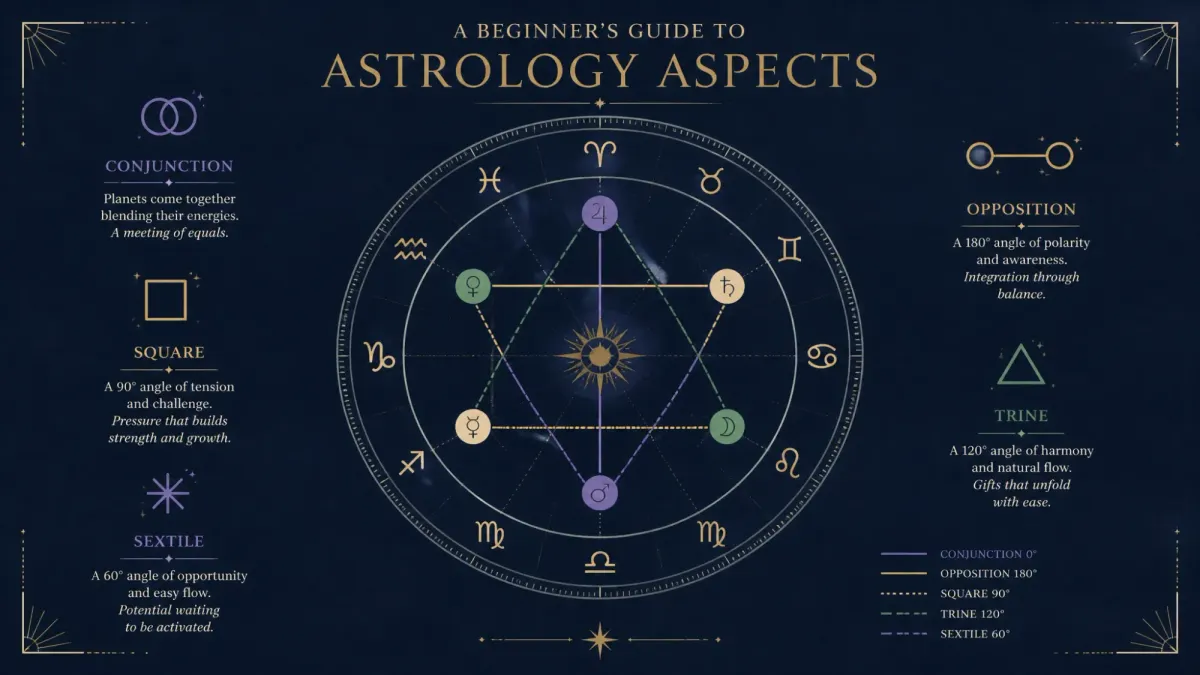
Astrology aspects are the angular relationships between planets and important chart points in a birth chart. They describe how different parts of the chart combine, support, challenge, or activate one another.
The five major astrology aspects are the conjunction, opposition, square, trine, and sextile. None is simply “good” or “bad.” An easy aspect can become passive, while a tense aspect can build awareness, motivation, and skill.
What are astrology aspects?
Imagine the birth chart as a 360-degree circle. The distance between two planets creates an angle. When that angle is close to a recognized geometric relationship, astrologers call it an aspect.
Aspects connect the chart’s core building blocks. Planets describe what is acting, signs describe how it acts, houses describe where it acts, and aspects describe how the planets relate. A useful interpretation brings these layers together instead of reading one placement as a fixed verdict.
The five major aspects at a glance
- Conjunction — 0°: planets combine and intensify.
- Opposition — 180°: two poles seek balance and awareness.
- Square — 90°: friction creates pressure and action.
- Trine — 120°: energy flows with relative ease.
- Sextile — 60°: cooperation creates an available opportunity.
Conjunction: planets working together
A conjunction places planets close together, blending their functions. The combination can feel focused and powerful, although separating the two needs may take practice. Its expression depends on the planets, sign, house, and exact distance between them.
For example, a Moon–Venus conjunction may link emotional comfort with affection, beauty, or connection. The sign shows the style of expression, while the house points to the life area where the blend is most noticeable.
Opposition: awareness through contrast
An opposition connects planets across the chart. It can describe competing needs, projection, or a relationship between two life areas. Integration comes from making room for both sides rather than choosing one permanently.
A Sun–Moon opposition, for instance, may highlight a dialogue between conscious direction and emotional needs. The aim is not to defeat one side, but to notice how the two can inform each other.
Square: productive friction
A square creates tension that is difficult to ignore. It can show frustration or conflicting strategies, but it can also build persistence and skill when the underlying needs are addressed consciously.
With a Moon–Mars square, emotional reactions and direct action may move at different speeds. Awareness can create more choice around when to pause, respond, or use that energy constructively.
Trine: natural flow
A trine connects signs of the same element and is associated with ease, talent, or familiar patterns. Because the energy flows readily, it may need intention before its potential becomes visible.
A Mercury–Jupiter trine might support broad thinking or an instinct for connecting ideas. Its ease does not guarantee a particular outcome; practice helps turn a natural tendency into a reliable skill.
Sextile: an opportunity to cooperate
A sextile links compatible elements and suggests functions that can support one another. It is often described as an opportunity because participation and practice help activate it.
For example, a Venus–Saturn sextile may support patient relationship-building or disciplined creative work when the person chooses to develop those qualities.
What is an aspect orb?
An orb is the distance between an exact aspect and the planets’ actual positions. A square is exact at 90°, but planets at 87° apart form a square with a 3° orb. Smaller orbs are generally read as stronger or more noticeable.
Astrologers use different orb ranges. Many allow more room for the Sun and Moon and use tighter orbs for minor aspects. There is no single universal orb system, so consistency matters more than treating one set of numbers as absolute.
How to interpret an aspect step by step
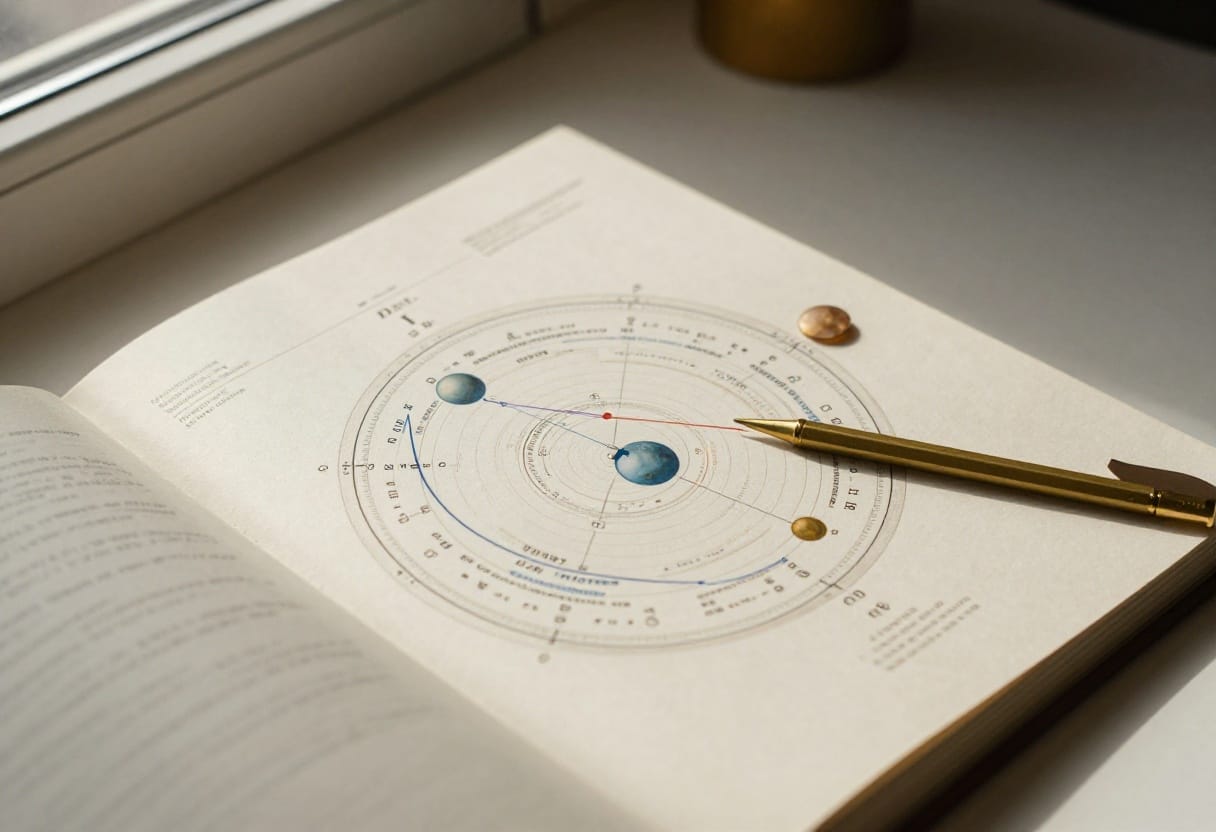
Connect aspects with the rest of the chart using Astrology for Beginners rather than memorizing isolated keywords.
- Name the two planets. What function or need does each represent?
- Identify the aspect. Does the relationship blend, polarize, challenge, flow, or invite cooperation?
- Add the signs. How does each planet tend to express itself?
- Add the houses. Which life areas are connected?
- Check the orb. Tighter aspects usually deserve more attention.
- Look for repetition. Repeated themes, angular planets, or connections to the chart ruler may carry more weight.
A simple interpretation example
Suppose Mercury in the third house squares Saturn in the sixth house. Mercury describes thinking and communication; Saturn adds structure, limits, and responsibility. The square suggests friction that may require effort. The houses connect communication or learning with routines, work, or daily responsibilities.
A grounded interpretation might explore careful speech, self-criticism, disciplined study, or the need to build confidence through repetition. The chart does not dictate one outcome. It offers a symbolic pattern to compare with lived experience.
Applying and separating aspects
Some astrologers distinguish between applying aspects, in which the faster planet is moving toward exact contact, and separating aspects, in which it is moving away. Applying aspects are often treated as building or becoming more immediate; separating aspects may describe an established pattern or something already experienced.
This distinction adds nuance, but it does not override the planets, signs, houses, orb, and overall chart pattern. Different astrological traditions weigh applying and separating aspects differently.
Astrology aspects FAQ
What is the strongest aspect in astrology?
There is no single strongest aspect in every chart. A very tight conjunction, square, opposition, trine, or sextile can be prominent, especially when it involves the Sun, Moon, Ascendant, Midheaven, or chart ruler. Repeated themes and close orbs usually matter more than ranking aspect types in isolation.
Are squares and oppositions bad?
No. Squares and oppositions describe tension, contrast, or competing needs, but they can also support motivation, awareness, and growth. Trines and sextiles describe easier flow, yet that ease may remain underused without attention and practice.
Do aspects matter more than zodiac signs?
They answer different questions. Planets show what is acting, signs show how it acts, houses show where it acts, and aspects show how the planets relate. Interpretation works best when all four layers are considered together.
How many aspects should a beginner interpret?
Begin with the five major aspects and the tightest orbs. Add connections to the Sun, Moon, Ascendant, Midheaven, and chart ruler before moving to minor aspects. A few well-integrated observations are more useful than a long list of disconnected meanings.
Do minor aspects matter?
Minor aspects can add detail, especially when they are exact or repeat an existing theme. Beginners can treat them as a second layer after understanding conjunctions, oppositions, squares, trines, and sextiles.
A grounded approach to interpretation
Astrology is a symbolic and reflective practice, not a scientific method of prediction. Use chart interpretations as prompts for self-inquiry rather than fixed judgments. Astrology cannot replace medical, legal, financial, mental-health, or other professional advice.
Keep learning with Astrological Insights
Explore the astrology learning hub or continue with Astrology for Beginners to connect signs, planets, houses, and aspects.
Join the free weekly newsletter for one practical astrology note, one tarot reflection prompt, and the newest beginner guide.