
The 12 Houses in Astrology: A Beginner’s Guide
Learn what the 12 houses in astrology mean and how to read identity, money, relationships, career, community, and more in your birth chart.
The 12 houses in astrology describe the areas of life where the signs, planets, and aspects in a birth chart tend to show up. They cover everything from identity and money to relationships, career, community, and inner life.
If you are new to reading a birth chart, think of it this way: planets describe what is happening, signs describe how it happens, and houses describe where it happens. This beginner-friendly guide explains the meaning of each astrology house and shows you how to start interpreting them in your own chart.
What are the houses in astrology?
An astrology chart is divided into 12 sections called houses. Each house represents a different part of human experience. The First House begins at the Ascendant, or Rising sign, and the remaining houses move counterclockwise around the chart.
Your exact house placements depend on your birth date, location, and especially your birth time. Even a small change in birth time can shift the Ascendant and house cusps, so use the most accurate time available. Different house systems can also place a planet in a neighboring house; that does not make one chart “wrong.” It simply gives you another interpretive lens.
The 12 houses in astrology and their meanings
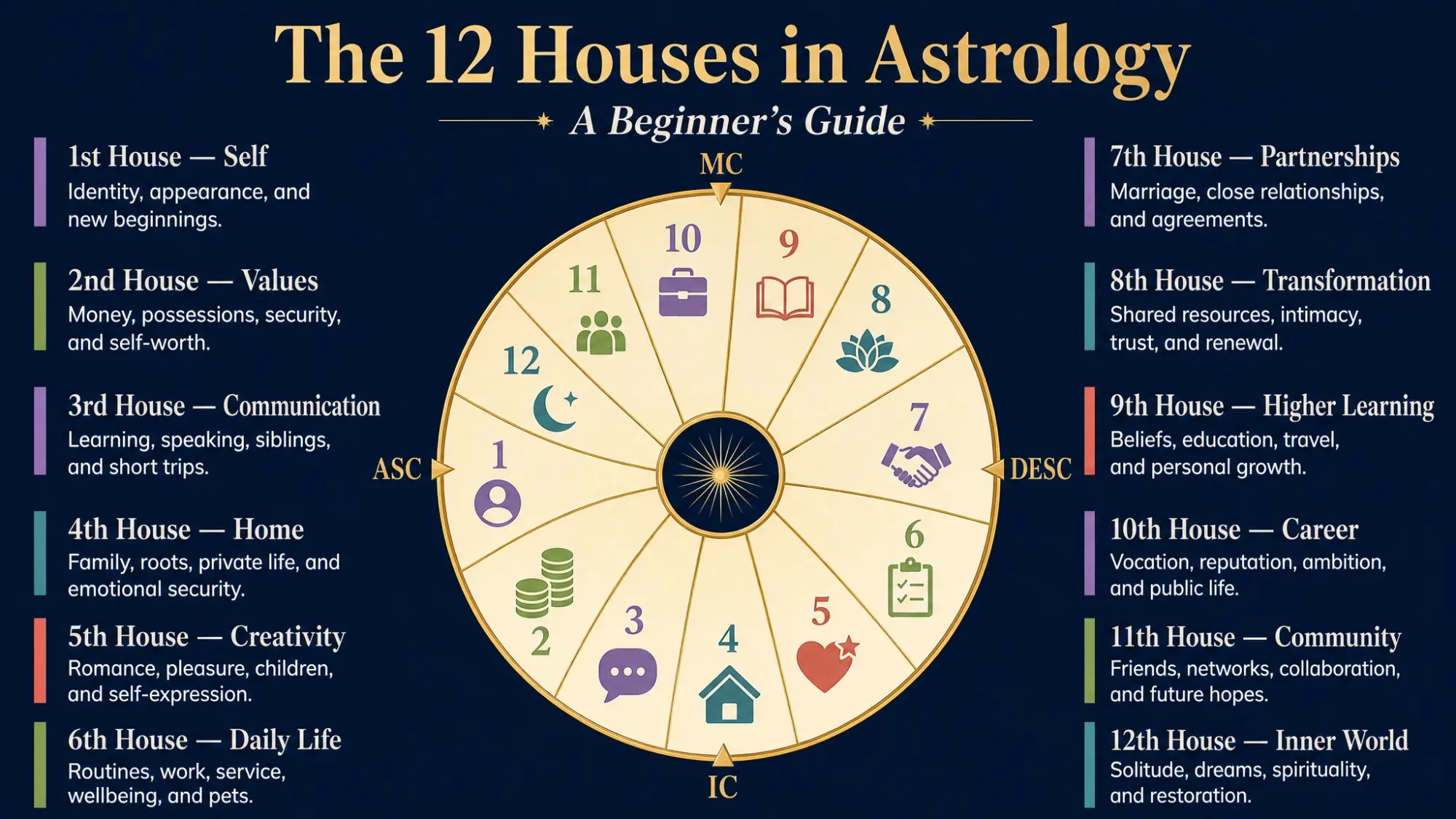
1st House: identity, appearance, and beginnings
The First House describes how you enter the world: your approach to new situations, your outward style, your instincts, and the first impression you make. Because the Ascendant begins here, this house is central to understanding how you move through life.
Look here for: identity, self-image, appearance, personal initiative, and fresh starts.
2nd House: money, possessions, and values
The Second House relates to what helps you feel secure and resourced. It can describe your relationship with income, spending, belongings, practical skills, and personal values. It also invites reflection on self-worth beyond material wealth.
Look here for: finances, possessions, earning ability, priorities, stability, and self-worth.
3rd House: communication, learning, and local life
The Third House shows how you gather and share everyday information. It is connected with speaking, writing, early education, siblings, neighbors, short trips, and the routines of your immediate environment.
Look here for: communication style, curiosity, siblings, local community, study, and short journeys.
4th House: home, family, and emotional roots
The Fourth House sits at the base of the chart and concerns your private foundation. It can reflect home life, family patterns, ancestry, belonging, and what you need in order to feel emotionally grounded.
Look here for: home, family, roots, private life, caregiving, and emotional security.
5th House: creativity, pleasure, and self-expression
The Fifth House is where you create, play, and express what makes you feel alive. It is associated with art, hobbies, romance, children, performance, risk-taking, and the experience of joy.
Look here for: creativity, dating, fun, children, hobbies, confidence, and personal expression.
6th House: routines, work, service, and wellbeing
The Sixth House focuses on the systems that support daily life. It can describe work habits, responsibilities, service, health routines, skills, and relationships with coworkers or animals. Interpret health symbolism reflectively, not as a diagnosis.
Look here for: habits, schedules, daily work, service, practical skills, health routines, and pets.
7th House: partnerships and one-to-one relationships
Opposite the First House, the Seventh House shifts attention from self to other. It covers committed relationships, close partnerships, contracts, negotiation, and the qualities you seek or encounter in one-to-one bonds.
Look here for: marriage, business partners, close relationships, agreements, cooperation, and conflict.
8th House: shared resources, intimacy, and transformation
The Eighth House deals with what is shared, merged, or changed through deep involvement with others. Its themes can include intimacy, trust, inheritance, debt, taxes, grief, psychological growth, and renewal.
Look here for: shared money, vulnerability, trust, endings, inheritance, healing, and transformation.
9th House: belief, travel, and higher learning
The Ninth House broadens your perspective. It relates to higher education, long-distance travel, philosophy, religion, publishing, law, and the search for meaning. It asks which experiences help you build a larger view of life.
Look here for: beliefs, university study, teaching, publishing, distant travel, culture, and purpose.
10th House: career, reputation, and public life
At the top of the chart, the Tenth House describes public contribution and long-term direction. It may show how you approach career, responsibility, leadership, achievement, reputation, and the legacy you hope to build.
Look here for: career, vocation, ambition, visibility, authority, public roles, and major goals.
11th House: friends, groups, and future hopes
The Eleventh House connects you with communities and collective aims. It can describe friendships, professional networks, social groups, audiences, causes, collaboration, and the future you imagine with others.
Look here for: friends, networks, community, teamwork, social causes, technology, and long-term hopes.
12th House: rest, solitude, and the inner world
The Twelfth House concerns what happens behind the scenes or below conscious awareness. It is linked with retreat, rest, dreams, spirituality, compassion, endings, hidden patterns, and the need to release what has run its course.
Look here for: solitude, sleep, intuition, the unconscious, closure, spiritual practice, and restoration.
How to interpret houses in your birth chart
You do not need to understand the entire chart at once. Choose one house and work through these four layers:
- Find the sign on the house cusp. The sign describes the style or approach you may bring to that area of life.
- Notice any planets in the house. A planet adds its needs and functions to the house’s topics. Learn more in our guide to the planets in astrology.
- Find the house ruler. Look to the planet that rules the cusp sign, then note its sign, house, and major aspects.
- Compare the symbolism with lived experience. Write down what fits, what does not, and what may be developing over time.
For the full chart-reading process, start with our beginner’s guide to reading a birth chart, or browse the Astrology for Beginners hub.
Angular, succedent, and cadent houses
The houses are also grouped into three modes:
- Angular houses (1, 4, 7, and 10) begin each quadrant and are associated with action, visibility, and major life foundations.
- Succedent houses (2, 5, 8, and 11) follow the angular houses and are associated with developing, maintaining, and stabilizing resources.
- Cadent houses (3, 6, 9, and 12) complete each quadrant and are associated with learning, adjustment, reflection, and transition.
This grouping can help you see where a chart feels most immediate, steady, or adaptable.
Common questions about astrology houses
What does an empty house mean?
An empty house is not missing or inactive. Everyone has all 12 houses, but not every house contains a planet. Read the sign on the cusp and the placement of its ruling planet to understand that area of life.
Are houses the same as zodiac signs?
No. Houses and signs are separate parts of the chart. A common teaching tradition pairs the First House with Aries, the Second with Taurus, and so on, but those associations are not interchangeable. Your First House can begin in any zodiac sign.
Which astrology house is the most important?
No single house tells the whole story. The First, Fourth, Seventh, and Tenth Houses often stand out because they anchor the chart, but the most active house for you depends on your planets, rulers, aspects, and current life context.
Can house placements change?
Your natal houses stay fixed once an accurate birth time and house system are chosen. However, transiting planets move through the houses over time, bringing temporary attention to different areas of life.
A simple way to keep learning
Begin with the house that contains your Sun, Moon, or chart ruler. Journal about its themes before reading several interpretations, then compare the symbolism with your own experience. Astrology is most useful when it supports curiosity and reflection rather than forcing one fixed answer.
Want one practical astrology note, one tarot reflection, and the newest beginner guide each week? Join the free Astrological Insights newsletter.
A note on interpretation
Astrology and tarot are reflective practices. They can support self-inquiry, but they do not provide certainty or replace medical, legal, financial, mental-health, or other professional advice.