
Tarot vs. Oracle Cards: Which Deck Is Right for You?
Tarot offers a structured symbolic system, while oracle cards provide more open and direct guidance. Explore how each deck works and discover which practice best supports your intuition right now.
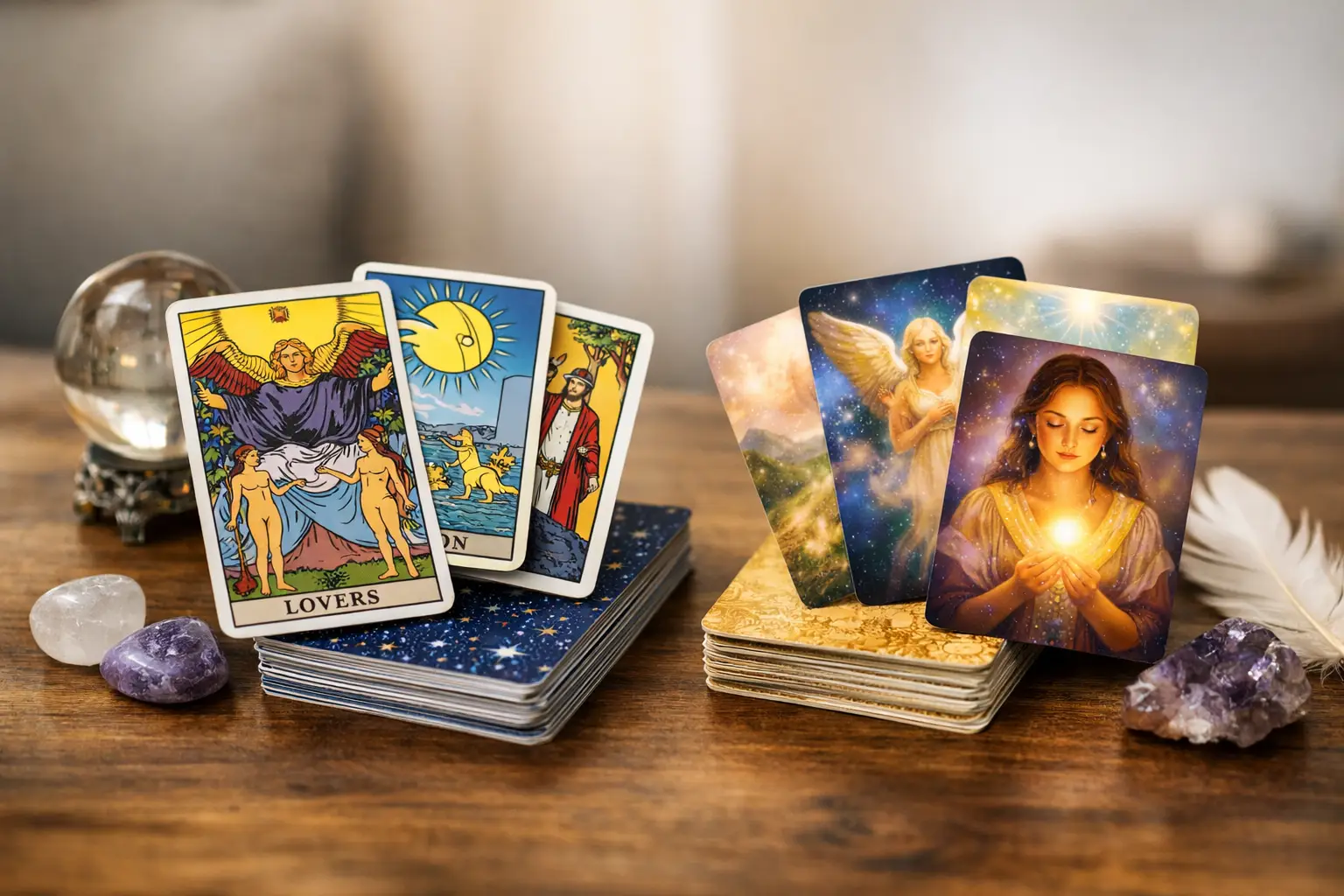
A beautiful deck can feel as though it chose you. You may be drawn to a card’s colors, a familiar symbol, or a message that lands exactly where your heart has been searching for direction. Yet when you begin comparing tarot versus oracle, the number of choices can feel surprisingly confusing. Both offer meaningful guidance, but they speak in different symbolic languages.
Tarot gives you a structured map of human experience. Oracle cards offer a more open, direct conversation with your intuition. Neither is more spiritual, accurate, or powerful than the other. The right choice depends on what you need support with now: a deeper look at a repeating pattern, a gentle message for the day, or a ritual that helps you move through life with greater clarity.
Tarot versus oracle: the essential difference
The clearest distinction is structure. A traditional tarot deck contains 78 cards, divided into the 22 Major Arcana and the 56 Minor Arcana. The Major Arcana reflects larger life lessons and turning points, from The Fool’s leap into a new chapter to The World’s sense of integration and completion. The Minor Arcana brings those larger themes into everyday life through the four suits of Cups, Wands, Swords, and Pentacles.
Each tarot card has a traditional foundation, even though its imagery and artistic style may vary from deck to deck. The Two of Cups, for example, consistently speaks to connection, reciprocity, and emotional exchange. The Eight of Pentacles carries themes of devotion, learning, and steady skill-building. As you learn tarot, you are learning a symbolic system whose parts relate to one another. A guide to tarot card meanings for beginners can help you build that foundation without feeling pressured to memorize everything at once.
Oracle decks do not follow one universal format. One deck may contain 44 cards and focus on moon phases. Another may have 52 cards centered on affirmations, ancestral wisdom, angels, plants, animals, or sacred archetypes. The creator decides the number of cards, the central theme, and the meaning of each message.
That flexibility is oracle’s gift. A card may simply say, “Rest,” “Trust the timing,” or “Speak your truth.” You do not need to memorize suits, numbers, or archetypal sequences before receiving guidance. The message often meets you immediately, especially when your mind feels crowded and your spirit needs a clear place to land.
What tarot can reveal about your current chapter
Tarot is especially helpful when you want to understand the moving pieces of a situation. A three-card reading can show what is influencing a relationship, what you are being asked to acknowledge, and what energy may support your next step. Because the cards work as a connected system, tarot can reveal tension, progression, contrast, and choice.
Imagine you are unsure whether to remain in a job that no longer feels aligned. Drawing the Four of Cups, the Eight of Pentacles, and the Ace of Wands creates a layered picture. The Four of Cups may reflect emotional disengagement. The Eight of Pentacles asks you to consider your abilities and the work required to develop them. The Ace of Wands brings forward the spark of a new possibility. Rather than issuing a command, the reading helps you see the inner landscape around your decision.
Tarot also has room for complexity. The same card can hold different emphasis depending on the question, the surrounding cards, and your lived experience. The Tower does not have to mean disaster. It can point to a truth that breaks through denial, a structure that has become too restrictive, or a necessary release that creates room for a more honest foundation.
This depth is why many readers return to tarot during major transitions involving love, career, identity, grief, or personal growth. Tarot does ask for patience. At first, 78 cards can seem like a lot to learn. But you do not need to memorize every keyword before you begin. Let the imagery speak, then slowly build your understanding of the system through regular practice.
Tarot works well when you want context
Choose tarot when your question has layers. It can be especially supportive when you are trying to understand a recurring emotional pattern, the dynamics in a relationship, or the lesson within a period of uncertainty. Its structure makes it easier to notice how one energy leads to another.
Tarot pairs beautifully with astrology, too. If Mercury retrograde has brought old conversations back to the surface, a tarot spread can help you explore what still needs to be said. If a new moon has you setting intentions around home, belonging, or self-worth, tarot can reveal the beliefs and habits shaping that intention.
What oracle cards bring to your practice
Oracle cards are often more immediate. They can feel like a compassionate note from your wiser self, offering focus without requiring you to interpret a full symbolic framework. This makes oracle a natural companion for a morning check-in, a new moon intention-setting ritual, or a moment when you need to come back to your center.
Suppose you pull an oracle card with the message “Boundaries.” The guidance may invite you to notice where you have been overextending, avoiding a difficult conversation, or giving more energy than you can truly spare. The card does not need to tell the whole story to be useful. It gives you a theme to carry into your day with care and awareness.
The trade-off is that oracle decks can vary widely in depth and tone. Their guidebooks are often central to the experience, and the quality of interpretation depends on the deck creator’s vision. Some decks offer rich, reflective messages. Others feel more like short affirmations. Neither approach is wrong, but it is worth choosing a deck that feels emotionally honest rather than overly polished or vague.
Oracle works well when you need a clear anchor
Oracle can be the better fit when you are new to card reading, short on time, or seeking a single theme to guide your day. It is also a gentle choice when you are feeling tender. A direct message can offer reassurance without asking you to untangle a larger spread before you feel ready.
Many readers use oracle alongside tarot rather than choosing only one. You might begin a reading with an oracle card to set the overall energy, then use tarot to explore the situation in more detail. Or you may close a tarot spread with an oracle message that helps you turn insight into a compassionate next step.
How to choose between tarot and oracle cards
Start by considering the kind of relationship you want with your deck. If you enjoy learning symbols, noticing patterns, and gradually building a skill, tarot may feel deeply satisfying. It becomes a language you can return to for years, with new layers appearing as your life changes.
If you want a practice that feels simple, intuitive, and easy to maintain, oracle may be your doorway. The best deck is not the one with the most elaborate artwork or the most mystical reputation. It is the one you will actually reach for when you need guidance.
Notice the artwork, too. Tarot and oracle are visual practices. Choose images that make you pause, feel, and wonder. A deck does not have to be traditionally styled to be meaningful, but its imagery should invite honest reflection. If the artwork leaves you cold or the guidebook language feels disconnected from your values, let that be useful information.
You can also begin with one deck and allow your practice to evolve. There is no need to buy several decks before you have formed a relationship with the first one. Pull a card at the same time each day for a few weeks. Write down what you notice before reading the guidebook, then return in the evening and reflect on how the card’s energy appeared in your choices, emotions, conversations, or thoughts.
A simple way to work with either deck
Create a small pause before you draw. Take a breath, place both feet on the floor, and name what you are seeking. Your question does not need to be perfect. “What energy needs my attention today?” is enough. “What can help me approach this relationship with more honesty?” is enough.
With tarot, begin with one card or an easy one-card tarot reading. You can also use a simple three-card spread. Ask what the card reflects, what it challenges, and what action or awareness it invites. With oracle, read the message slowly and ask where it touches your real life. Let the card guide reflection, not replace your own agency.
Cards are most helpful when they bring you into a more honest relationship with yourself. A reading can name the fear beneath your indecision, the hope beneath your longing, or the strength you have overlooked. It can also remind you that timing matters, and that clarity sometimes arrives through one small, grounded choice.
Whether tarot’s layered archetypes call to you or oracle’s direct messages feel like the support you need, let your deck become a steady ritual of listening. The guidance is not asking you to have every answer at once. It is inviting you to meet the chapter unfolding before you with curiosity, courage, and a little more trust in your own inner wisdom.