
Birth Chart Interpretation Examples, Explained
Learn how to interpret birth chart placements together, from the Sun, Moon, and Rising sign to houses, aspects, relationships, emotions, and career direction.
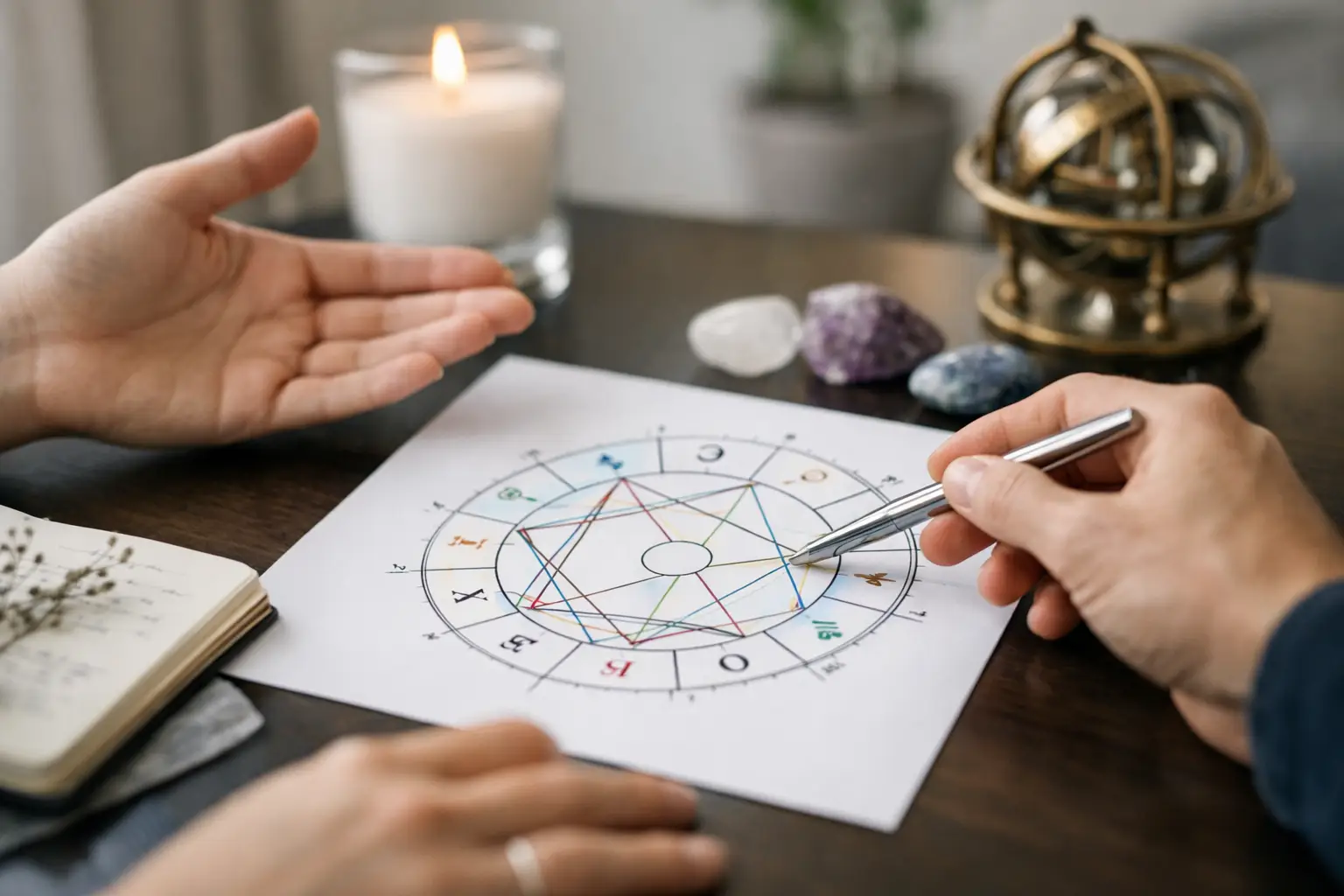
A birth chart can look like a beautiful puzzle at first: symbols, lines, twelve houses, and planets placed in signs. Birth chart interpretation examples make that puzzle personal. Instead of memorizing isolated meanings, you begin to see how your emotional needs, relationship patterns, ambitions, and growing edges speak to one another.
Your chart is not a fixed script. It is a map of the energies you arrived with and the recurring themes asking for your attention. A strong interpretation holds both the gifts and the tensions in that map, helping you move through life with greater clarity and self-understanding.
How to read birth chart interpretation examples
If you are new to chart reading, begin with a simple approach to reading your birth chart. The most helpful starting point is the three foundations known as the Sun, Moon, and Rising sign.
Your Sun sign points to your core identity and the kind of purpose that helps you feel fully yourself. Your Moon sign describes your emotional instincts, comfort needs, and private inner world. Your Rising sign, also called the Ascendant, shows how you meet new experiences and the first energy others often notice.
Next, look at house placement. Houses show where an energy tends to play out in daily life. Venus may speak to love, pleasure, values, and connection in any chart, but Venus in the seventh house places those themes strongly into partnership. Venus in the tenth house may bring them into public life, career, or reputation. A guide to the 12 astrology houses can help you understand these life areas.
Finally, consider the aspects in your birth chart, which are the angles planets form with one another. A harmonious aspect can show qualities that work together naturally. A more challenging aspect can reveal an inner push and pull that becomes a source of growth when handled consciously. No single placement tells the whole story.
Birth chart interpretation examples for identity and emotions
Example: Leo Sun, Pisces Moon, Virgo Rising
Imagine a chart with a Leo Sun, Pisces Moon, and Virgo Rising. At the center, this person has a Leo need to create, express, lead, and be recognized for what is uniquely theirs. They come alive when their warmth is welcomed and when their talents have somewhere meaningful to go.
Yet a Pisces Moon brings an emotional life that is receptive, imaginative, and deeply sensitive to atmosphere. This person may absorb the moods of a room before naming their own feelings. They need quiet, art, spiritual reflection, or time near water to clear emotional static and return to themselves.
Virgo Rising changes the first impression. Others may see this person as thoughtful, capable, organized, or somewhat reserved before noticing the bold Leo heart underneath. In everyday life, they may try to earn confidence by getting everything right. The growth path is to let Virgo’s discernment support Leo’s creativity rather than allowing perfectionism to delay self-expression.
If this Leo Sun falls in the eleventh house, friendships, community, and long-range dreams become central to the person’s identity. They may be the one who brings warmth and vision to a group while also needing friends who appreciate their sensitivity rather than expecting them to perform all the time.
Example: Capricorn Sun, Aries Moon, Cancer Rising
Now consider a Capricorn Sun, Aries Moon, and Cancer Rising. Capricorn gives this person a serious relationship with goals, integrity, and lasting achievement. They often feel most secure when building something real, whether that means a career, a skill, financial stability, or a life they can respect.
An Aries Moon, however, feels quickly and directly. When frustrated, this person may need space to move, speak honestly, or take immediate action. They do not thrive when emotions are buried beneath a long list of responsibilities. Their feelings want acknowledgment before they become irritation.
Cancer Rising adds a tender outer layer. People may come to this person for care, reassurance, or emotional safety, even when they privately feel driven to handle everything alone. This combination can create someone who appears gentle but has remarkable inner force. Their work is to honor both needs: Cancer’s desire for belonging and Capricorn’s desire for self-reliance.
In love, this chart may need a partner who respects ambition without mistaking it for emotional distance. Direct conversations help. So does recognizing that needing support is not a failure of strength.
An example of love and relationship patterns
Venus and Mars offer rich insight into attraction, desire, affection, and the way you pursue what matters. Consider someone with Venus in Libra in the seventh house and Mars in Scorpio in the fifth house.
Venus in Libra seeks balance, beauty, fairness, and genuine partnership. In the seventh house, relationships are not a side note in this person’s life. They are a powerful mirror, often teaching them about compromise, boundaries, and what reciprocity truly feels like. This person may have a gift for seeing both sides but struggle when keeping the peace means abandoning a personal preference.
Mars in Scorpio in the fifth house adds a far more intense current. Romance, creativity, pleasure, and self-expression carry depth for this person. They are unlikely to feel fulfilled by casual attention alone. They want emotional honesty, loyalty, and a sense that their passion has somewhere safe to land.
Together, these placements can create someone who presents as gracious and easygoing but feels love with enormous intensity. The guidance here is to name desires earlier. The more clearly this person states what they need, the less likely they are to drift into relationships where harmony looks good from the outside but leaves them emotionally undernourished.
An example of career direction and purpose
Career interpretation is often less about finding one perfect job title and more about understanding the conditions in which your energy can flourish. Look to the tenth house, Midheaven, Sun, Saturn, and planets that sit near the top of the chart.
Picture a Gemini Midheaven with Mercury in the tenth house and a Taurus Sun in the second house. Gemini at the Midheaven often brings a public path involving communication, curiosity, teaching, writing, networking, media, sales, or work that requires translating ideas for different people. Mercury in the tenth strengthens the need to be heard for one’s mind, perspective, and ability to connect information.
The Taurus Sun in the second house grounds that quick Gemini energy. This person may need their work to create tangible value. They might thrive by turning communication skills into stable income through a practical specialty, a trusted personal brand, or a service that helps others make clear choices. They may dislike career paths that feel constantly scattered, even if they enjoy variety.
The challenge is not choosing between stability and curiosity. It is designing a rhythm that honors both. A reliable foundation can give this person the freedom to experiment, speak up, and follow their ideas where they lead.
How aspects change the story
Aspects add emotional texture. For example, a Moon square Saturn can describe someone who learned early to be composed, responsible, or careful with vulnerability. They may be deeply dependable in a crisis yet find it difficult to ask for comfort when they are hurting.
This is not a sign that love or ease is unavailable. It points to an invitation to build emotional trust gradually. Rest, honest self-talk, and relationships with consistent boundaries can be especially healing. Over time, people with Moon-Saturn patterns often become wise, steady sources of support because they understand the value of showing up.
A Sun trine Jupiter carries a different quality. It often supports faith, generosity, and a natural ability to see possibility. This person may inspire others simply by believing growth is possible. Their balance point is to pair optimism with follow-through, especially when an exciting opportunity appears.
When you interpret aspects, ask what two needs are trying to cooperate. That answer is usually more useful than labeling an aspect as simply good or bad.
Let your chart become a conversation
When you look at your own placements, begin with what feels most alive right now. If relationships are changing, explore Venus, Mars, the seventh house, and your Moon. If work feels uncertain, look toward the tenth house, Saturn, and the ruler of your Midheaven. If you are questioning who you are becoming, return to your Sun, Rising sign, and the house where your Sun lives.
Celestial wisdom becomes most useful when it gives language to an experience you are already carrying. Sit with one placement at a time, notice its patterns in your life, and choose one small way to work with its energy this week. Your chart will continue to reveal itself as you do.