
Astrology Houses for Beginners: A Clear Guide to the 12 Houses
Astrology houses show where the energies in your birth chart unfold, from identity and relationships to career, intuition, and personal growth. Learn what all 12 houses reveal and how to read them with greater clarity.
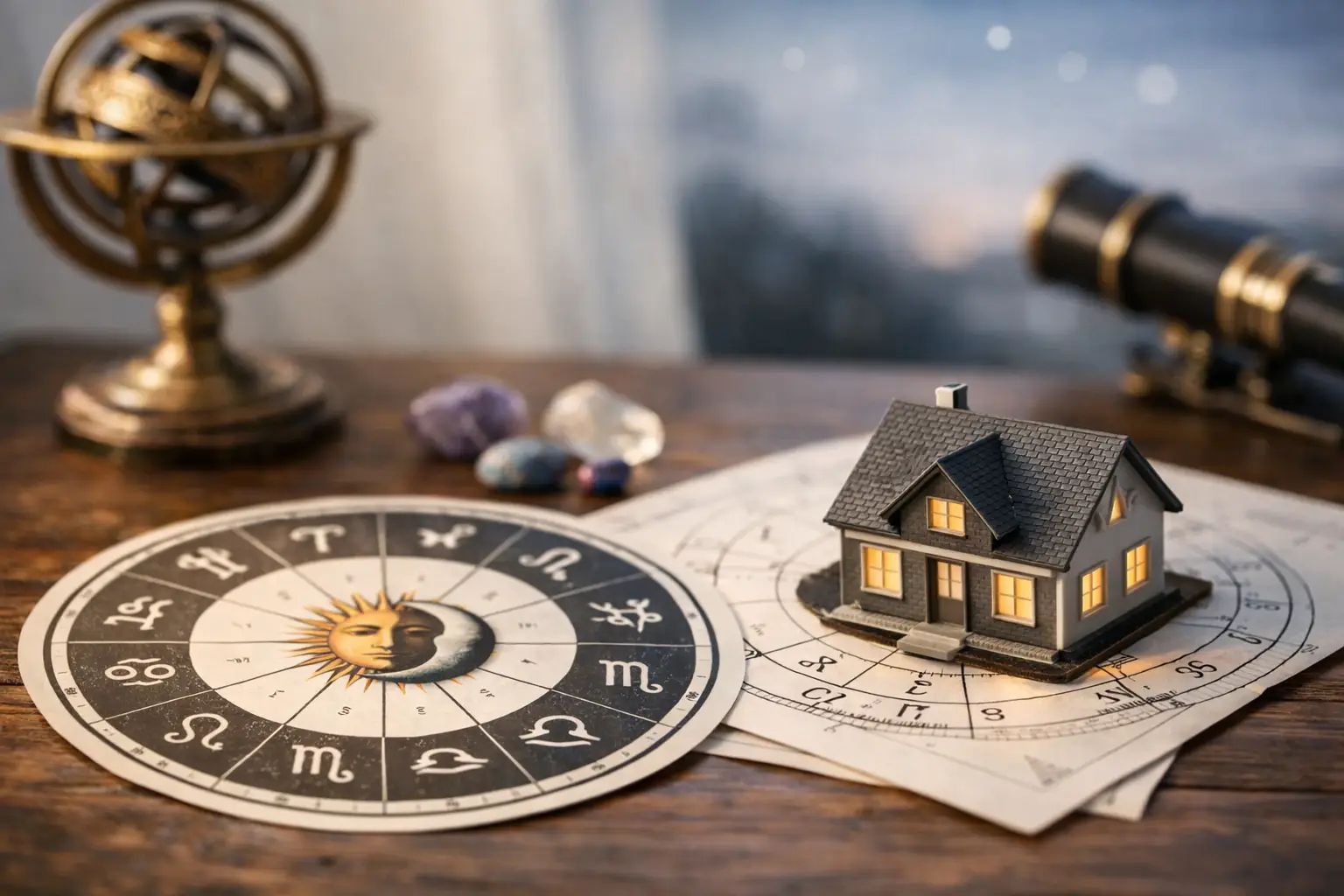
A birth chart can look like a celestial wheel crowded with symbols, but astrology houses for beginners become much easier to understand when you see what they represent: the living areas of your life. Your planets describe the energies you carry. Your zodiac signs show how those energies express themselves. The houses reveal where those patterns unfold—in love, work, family, friendships, purpose, and the private corners of your inner world.
Think of the houses as twelve rooms in the home of your chart. Every room has a purpose. Some may be full of planetary activity, while others are quieter. Neither is better. A quiet house is not an empty promise or a missing part of your life. It simply means that area is shaped more by its ruling sign, current transits, and your choices than by a natal planet sitting there.
What Are Astrology Houses?
The twelve houses begin at the Ascendant, also called your rising sign. This is the sign that was rising on the eastern horizon at your moment of birth, which is why an accurate birth time matters so much. From there, the chart divides into twelve sections, each connected to a core life theme.
If planets are the characters in your story and signs are their style of expression, houses are the settings where the story takes place. For example, Venus in Leo may love generously and visibly. Venus in the seventh house brings that affectionate, expressive energy into close relationships and partnership. Venus in the tenth house may draw it into career, reputation, or a public-facing creative path.
This is why two people with the same Sun sign can feel so different. Their Suns may occupy different houses, placing their sense of identity in very different parts of life.
What Are the Angular Houses?
The angular houses are the first, fourth, seventh, and tenth houses. They are associated with two major chart axes: the horizon axis, formed by the Ascendant and Descendant, and the meridian axis, formed by the Midheaven and Imum Coeli. Their exact zodiac degrees depend on the birth time and location.
First house — Ascendant (ASC): The Ascendant is where the ecliptic intersects the eastern horizon. It marks the rising degree and describes how the chart meets the world, including themes of identity, embodiment, and initiation.
Seventh house — Descendant (DSC): Directly opposite the Ascendant, the Descendant marks the western horizon. It anchors themes of partnership, significant others, collaboration, and what is encountered through one-to-one relationships.
Tenth-house axis — Midheaven (MC): The Midheaven is the upper intersection of the ecliptic with the local meridian. In many quadrant house systems it forms the tenth-house cusp and is associated with public direction, vocation, visibility, and reputation.
Fourth-house axis — Imum Coeli (IC): Opposite the Midheaven, the IC is the lower intersection of the ecliptic with the local meridian. It is associated with home, roots, ancestry, privacy, and the foundations that support public life.
Together, these angles provide the chart’s orientation. In quadrant systems they commonly define the angular house cusps. In Whole Sign houses, the Ascendant determines the first whole-sign house, while the MC and IC remain important chart points even when they fall outside the tenth and fourth houses.
Why Interpret Houses Through an Archetypal Lens?
An archetypal approach treats the houses as recurring domains of human experience rather than isolated boxes. The sequence moves from the first house’s emergence of self through relationships, contribution, community, release, and renewal. This broader pattern can help a chart feel like a connected story instead of twelve unrelated topics.
Evolutionary astrologers may use the houses to explore how a person develops through particular life arenas. A planet’s house can then describe more than where a theme appears; it can prompt questions about why that area matters, what patterns keep returning, and what a more conscious response might look like.
This is a reflective lens, not proof of a predetermined purpose or “soul lesson.” Use archetypal language to deepen inquiry while leaving room for culture, circumstances, personal choice, and more than one valid interpretation.
The 12 Astrology Houses for Beginners
First House: Identity and First Impressions
The first house is your arrival point. It speaks to your presence, physical energy, instinctive approach to life, and the impression you make before people know your full story. Your rising sign begins here, making this house a powerful key to how you move through the world.
A strong first house can make self-definition an ongoing theme. You may feel called to grow into a more authentic version of yourself, especially during major transits here.
Second House: Money, Values, and Self-Worth
The second house is often associated with income and possessions, but its deeper message is value. It shows your relationship with resources, security, talents, and the belief that you deserve support.
When this house is activated, practical questions may rise to the surface: What do I need to feel stable? What gifts am I underestimating? Where am I giving away my time, energy, or money without honoring my worth?
Third House: Communication and Everyday Life
The third house governs learning, communication, local community, siblings, short trips, and the rhythms of daily life. It is the house of texts, conversations, errands, curiosity, and the information you take in each day.
Planets here often make the mind active and observant. This house can also show how you find your voice, especially when you need to say what has been sitting quietly in your heart.
Fourth House: Home, Family, and Emotional Roots
The fourth house sits at the bottom of the chart, close to your private foundation. It reflects home, family history, ancestry, childhood conditioning, and the emotional environment that helps you feel safe.
This is not only about the house you live in. It asks what home means to you. A fourth-house transit can bring moves, family shifts, memories, or a deep need to create stronger emotional roots within yourself.
Fifth House: Joy, Romance, and Creative Expression
The fifth house carries pleasure, dating, creativity, play, self-expression, and children. It is where your inner light wants to be seen. When life has felt overly serious, this house reminds you that joy is not a distraction from your path. It can be part of the path.
Look here for clues about the kind of romance and creative expression that makes you feel alive. This is the house that asks, without apology: What do you love?
Sixth House: Routines, Work, and Well-Being
The sixth house relates to your everyday responsibilities, work habits, service, health routines, and relationship with your body. It is less about grand career ambition and more about the systems that hold your life together.
A busy sixth house can point to a strong desire to be useful, though it can also bring a tendency to overextend yourself. Its wisdom is simple and profound: sustainable growth requires care, boundaries, and rhythms you can actually maintain.
Seventh House: Partnership and Commitment
The seventh house is the place of one-to-one relationships. Romantic partners, close collaborators, clients, and even open rivals can appear here. It shows what you seek, meet, and learn through significant others.
This house is not a prediction of whether you will marry. It offers insight into the relationship dynamics that call you toward balance and growth. Planets here often make connection a meaningful teacher, revealing both your desires and the patterns you are ready to understand more deeply.
Eighth House: Intimacy, Trust, and Transformation
The eighth house is one of the most misunderstood houses because it deals with themes beneath the surface: shared finances, intimacy, trust, grief, emotional merging, and transformation. It asks you to meet what feels vulnerable rather than avoiding it.
When this house is active, you may be working through questions of emotional honesty, debt, shared resources, or the courage to let an old identity fall away. Its changes can feel intense, but they often clear space for deeper self-possession.
Ninth House: Belief, Meaning, and Expansion
The ninth house reaches beyond the familiar. It is connected to higher learning, travel, spirituality, philosophy, publishing, and the beliefs that give your life meaning. While the third house gathers facts, the ninth house asks what those facts mean.
This house often becomes active when you are ready to broaden your perspective. You may feel drawn to study, travel, spiritual practice, or a truth that helps you see your life from a wider horizon.
Tenth House: Career, Calling, and Public Life
The tenth house is associated with career, recognition, life direction, and the role you grow into publicly. Its highest point, the Midheaven, can reveal the qualities you are learning to embody in your contribution to the world.
Career is part of this house, but it is not limited to job titles. A tenth-house emphasis may point to responsibility, visibility, leadership, or the desire to build a meaningful legacy on your own terms.
Eleventh House: Friendship, Community, and Future Dreams
The eleventh house speaks to friendships, networks, groups, collective causes, and hopes for the future. It shows how community can shape your vision and where shared interests create belonging.
This house is also associated with collaboration, progress, innovation, and reform. It asks not only what future you imagine, but how you participate in building it with other people.
Planets and signs here can describe your style within groups. You may contribute as a connector, organizer, advocate, researcher, supporter, or independent thinker. They can also highlight what you need from friendship and which communities encourage your growth.
When the eleventh house is emphasized, networking is not merely collecting contacts. It can mean finding reciprocal relationships, exchanging resources, and joining efforts that make a long-term goal more possible.
Twelfth House: Rest, Intuition, and the Unseen
The twelfth house is private, spiritual, and deeply reflective. It relates to dreams, solitude, intuition, healing, endings, and patterns that operate below conscious awareness. This is not a house to fear. It is where you can listen for what a busy mind may miss.
Astrological traditions also associate the twelfth house with surrender, limitations, retreat, and experiences that cannot be controlled through effort alone. These themes may invite acceptance, rest, grief work, or a more compassionate relationship with uncertainty.
Some psychological and spiritual approaches connect this house with the collective unconscious: symbols, memories, and emotional patterns that seem larger than the individual self. Treat that language as a reflective metaphor rather than a literal diagnosis or scientific claim.
Planets in the twelfth house often need quiet space to process. Time alone, journaling, therapy, prayer, creative work, and restorative rituals may help its themes become sources of insight and compassion rather than confusion or escape.
How to Read Houses in Your Birth Chart
Start with the house containing your Sun, Moon, and rising sign. Your Sun's house shows where you are developing confidence and purpose. Your Moon's house points toward emotional needs and the life area that feels especially personal. Your rising sign begins the first house and sets the sequence of signs across the rest of your chart.
Then notice which houses contain planets. A house with several planets may feel like an active classroom in this lifetime. Read the planet, sign, and house together. Mars in the second house may bring drive around earning and independence, while Mars in the fourth can make home and family dynamics a powerful source of motivation or tension.
For a broader foundation, you can also explore astrology for beginners before comparing house systems. Whole Sign houses place one full sign in each house, while Placidus and other systems can create houses of different sizes. Both approaches can offer meaningful insight. If you are new, choose one system and stay with it long enough to recognize its patterns before comparing methods.
Whole Sign houses assign one complete zodiac sign to each house. Equal House begins the first-house cusp at the exact Ascendant degree and divides the chart into twelve equal thirty-degree houses. Quadrant systems such as Placidus, Porphyry, and Koch use different time-and-space calculations and may produce houses of unequal size.
No house system is universally considered best. Choose one method, interpret it consistently, and compare systems only after you understand what each one is designed to show. When using Whole Sign or Equal houses, note the MC and IC separately rather than assuming they must always define the tenth- and fourth-house cusps.
Your houses are not a set of fixed instructions. They are a map of attention, revealing where celestial wisdom is asking you to become more conscious. Return to your chart when a relationship changes, a work decision approaches, or you are simply trying to understand what your heart needs next. Each house gives you another language for navigating life with greater clarity.