
Sun, Moon, and Rising Signs: Your Big Three Explained
Understand your Sun, Moon, and Rising signs, what each describes, and how the Big Three work together in a birth chart.
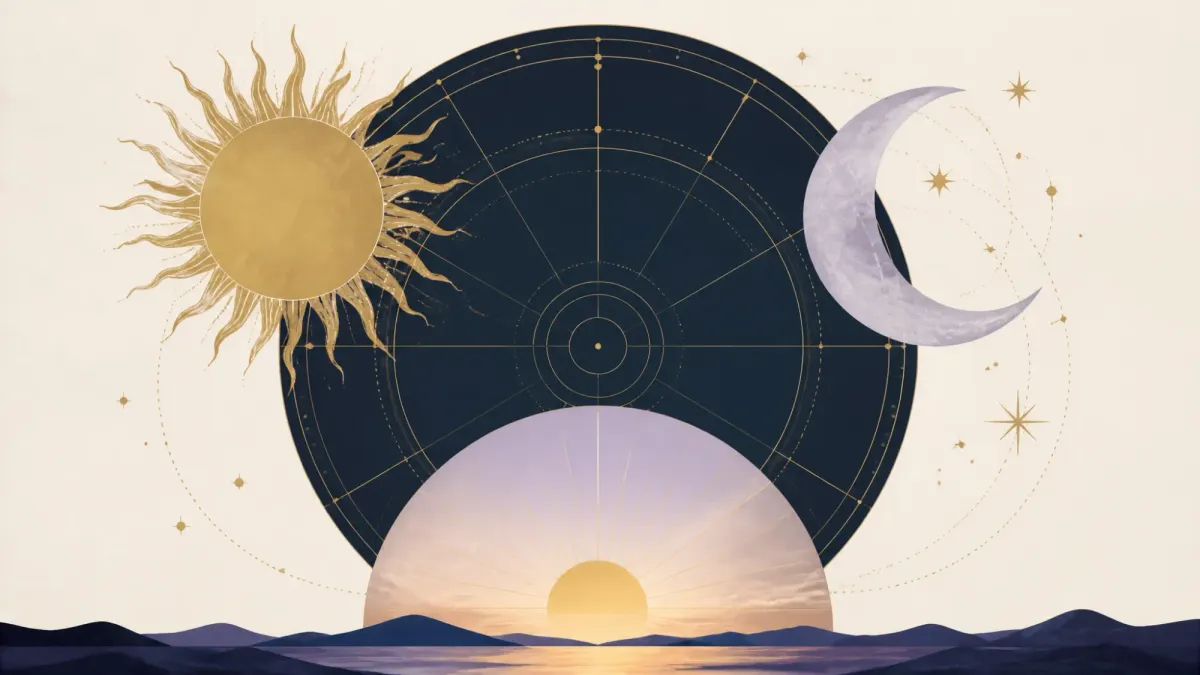
Your Sun, Moon, and Rising signs—often called the Big Three in astrology—describe three connected parts of your birth chart. The Sun relates to identity and the qualities you are learning to express, the Moon reflects emotional needs and instinctive responses, and the Rising sign describes how you approach life and sets up the houses of your chart.
The Big Three are not three competing personalities, and none is the single “real” you. They are starting points for understanding how your inner needs, developing sense of self, and way of meeting the world can work together.
What are the Big Three in astrology?
The Big Three are the Sun sign, Moon sign, and Rising sign (also called the Ascendant). Astrologers often begin with these placements because they offer a useful overview before adding the rest of the planets, houses, and aspects.
- Sun sign: identity, vitality, purpose, creative expression, and the qualities you grow into.
- Moon sign: emotional needs, comfort, habits, memory, and your private inner life.
- Rising sign: your outward approach, first impressions, and the starting point of the house system.
Your Big Three can share the same element or modality, or they may seem very different. Similarities can make a style feel natural and consistent. Contrasts can point to needs that require more conscious balance.
What your Sun sign means
The Sun is a central organizing symbol in the birth chart. It is associated with vitality, confidence, will, purpose, and creative self-expression. Your Sun sign can describe qualities that help you feel most fully yourself, especially as you develop them over time.
Your birth date determines your Sun sign, which is why it is the sign used in most newspaper and app horoscopes. But the sign is only one layer. The Sun’s house shows the area of life where these qualities are emphasized, while its aspects describe how the Sun interacts with other parts of the chart.
How to read your Sun sign
Begin with the element and modality of the sign. Fire, earth, air, and water describe broad styles of expression, while cardinal, fixed, and mutable signs describe different ways of initiating, sustaining, or adapting. Then ask where your Sun feels energized and what kind of meaningful contribution you want to make.
For example, a Gemini Sun may seek vitality through learning, exchanging ideas, and staying mentally engaged. Its expression will still differ depending on whether it falls in a public tenth house, a private fourth house, or forms close aspects to other planets.
What your Moon sign means
The Moon is associated with emotional regulation, comfort, memory, attachment, habits, and automatic responses. Its sign can suggest what helps you feel secure, how you respond when you do not have time to plan, and what restores you after stress.
Because the Moon moves through the zodiac quickly, your Moon sign is calculated from your birth date, time, and location. If the Moon changed signs on the day you were born, an accurate time may be especially important.
How to read your Moon sign
Ask what kind of environment helps this sign settle. An earth Moon may appreciate steadiness and tangible routines, while an air Moon may process feelings through conversation or perspective. These are broad symbolic themes, not rules about how someone must feel or behave.
The Moon’s house adds context. A Moon in the eleventh house may seek belonging through friendship and community, while a Moon in the second house may connect security with stability, values, or dependable resources.
What your Rising sign means
The Rising sign, or Ascendant, is the zodiac sign that was rising on the eastern horizon at the moment of birth. It depends on an accurate birth time and location and usually changes about every two hours, although the exact timing varies by latitude.
The Rising sign describes your orientation toward new situations: how you enter a room, begin something unfamiliar, and engage with your surroundings. It can influence first impressions, but it is more than a social mask. It is the lens through which the rest of the chart is organized.
The Ascendant begins the first house and determines how the signs fall across all 12 houses. That is why an accurate birth time matters so much. Read our guide to the 12 houses in astrology to understand what each area of the chart represents.
How to read your Rising sign
Start with the sign’s element, modality, and general approach. Then identify the planet that rules that sign. The ruling planet’s sign, house, and aspects provide more detail about how the Ascendant operates in everyday life.
For example, someone with Virgo Rising may approach new situations by observing, organizing, or looking for what can be improved. Mercury rules Virgo, so Mercury’s placement would show where and how that practical, analytical approach is expressed.
Sun vs. Moon vs. Rising: what is the difference?

A simple way to remember the difference is to think in terms of identity, needs, and approach:
- The Sun asks, “What helps me feel purposeful and fully alive?”
- The Moon asks, “What do I need to feel emotionally safe and restored?”
- The Rising sign asks, “How do I instinctively approach the world and begin new experiences?”
These questions overlap, but they are not interchangeable. You might identify strongly with your Moon during private or emotionally charged moments, notice your Rising sign most clearly in unfamiliar settings, and grow into your Sun’s qualities with experience.
How to calculate your Sun, Moon, and Rising signs
To calculate all three accurately, gather:
- Your full birth date.
- Your exact birth time, ideally from a birth certificate or another reliable record.
- Your birth city and country.
- A birth-chart calculator that clearly displays signs, houses, and degrees.
Your Sun sign is usually easy to find from the date alone. Your Moon sign may require the time if the Moon changed signs that day. Your Rising sign always depends on the time and location.
If you do not know your exact birth time, avoid guessing your Rising sign. You can still explore your Sun and, in many cases, your Moon. Treat any chart made with an estimated time as provisional because the Ascendant and house placements may be incorrect.
How to interpret your Big Three together
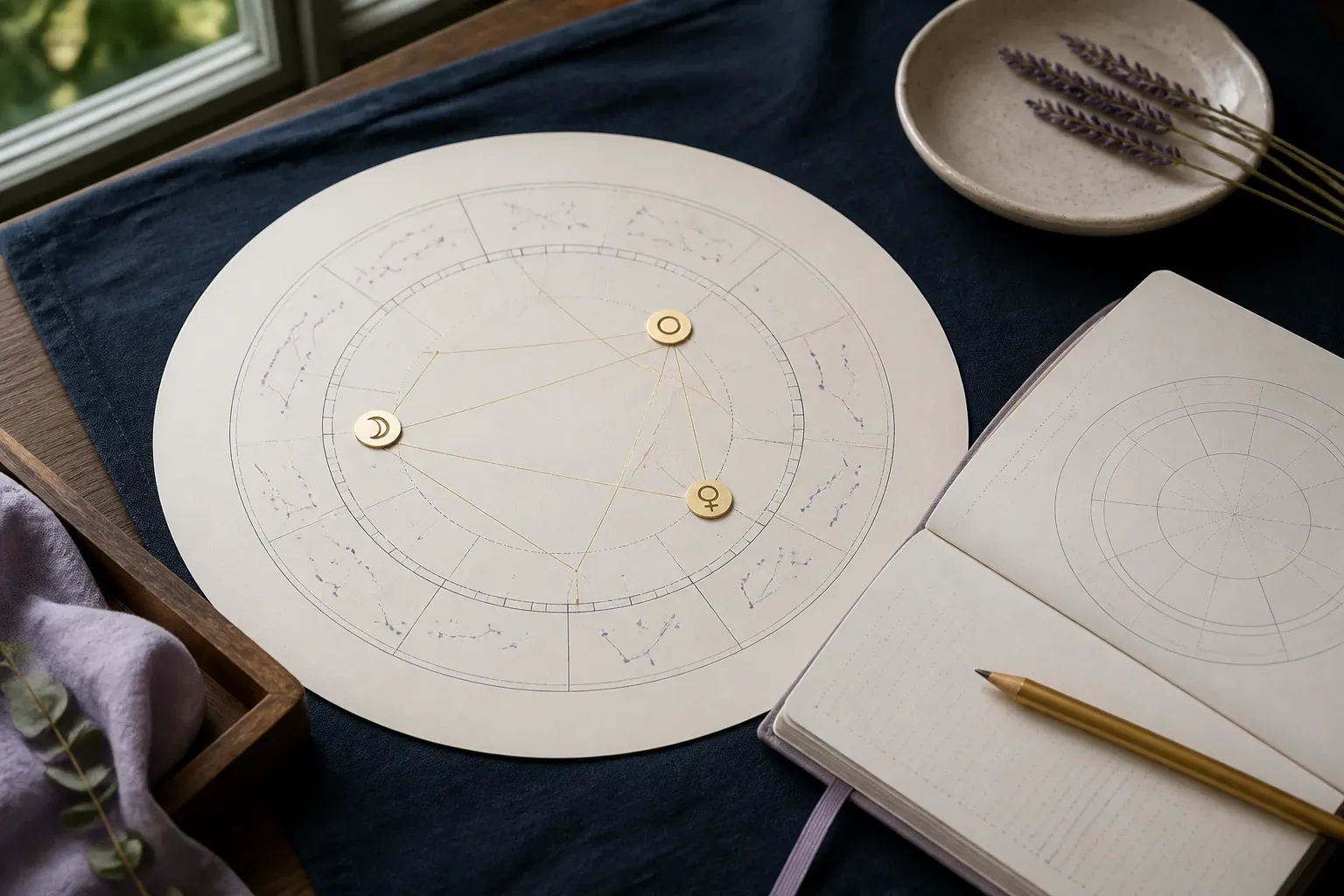
1. Read each placement separately
Write one or two neutral keywords for the Sun, Moon, and Rising sign. Focus on needs and tendencies rather than labels. This gives each placement room to speak before you try to combine them.
2. Look for shared elements and modalities
Notice repetition. Two or three placements in water signs may make emotional sensitivity and intuition more visible. Several fixed signs may emphasize persistence and consistency. If the placements differ, ask what each one contributes instead of treating the contrast as a flaw.
3. Notice where the signs support or challenge one another
A fire Sun and air Moon may energize one another through movement and ideas. An earth Moon with a fire Rising might describe a person who approaches life quickly but needs calm, predictable routines to reset. Contrast often shows where pacing and self-awareness are helpful.
4. Add houses, ruling planets, and aspects
The signs tell you how a placement tends to operate; the houses show where its themes are active. Aspects describe relationships between chart points. A full interpretation therefore goes beyond a list of three sign descriptions. If you are new to this process, our Astrology for Beginners guide explains how signs, planets, houses, and aspects fit together.
A worked Big Three example
Imagine a person with a Leo Sun, Taurus Moon, and Virgo Rising. The Leo Sun may value heartfelt creative expression. The Taurus Moon may need steadiness, comfort, and time to adjust. Virgo Rising may meet new situations with observation and practical problem-solving.
Read together, this combination could suggest someone who wants to express themselves warmly, feels best with a dependable emotional base, and initially appears measured or detail-aware. This is a reflective starting point, not a fixed personality verdict. Houses, aspects, life experience, culture, and personal choice all add context.
Common Big Three patterns
Two or three placements in the same sign
Repeated signs can concentrate a set of themes, but they do not make every placement identical. A Sun in Cancer still describes something different from a Moon in Cancer or Cancer Rising because the Sun, Moon, and Ascendant have different roles.
Placements in the same element
A shared element can create a recognizable style. A mostly air Big Three may emphasize ideas and connection, while a mostly earth Big Three may favor practicality and stability. Look for balance in the rest of the chart before assuming the repeated element tells the whole story.
Very different signs
Contrasting placements are common. They can describe different responses in different situations rather than inconsistency. Someone may need quiet emotional processing while presenting an energetic, sociable approach to the world.
Common misconceptions about the Big Three
- “My Rising sign is fake.” The Ascendant is not simply a mask; it describes your entry point into experience and structures the houses.
- “My Moon sign is my hidden true self.” The Moon is important, but no single placement overrides the whole chart.
- “One difficult combination determines my future.” Astrology does not remove choice. Tension can be explored as a dynamic to understand, not a sentence.
- “The Big Three are the whole birth chart.” They are a useful beginning. Mercury, Venus, Mars, the outer planets, houses, and aspects add essential detail.
Frequently asked questions
Which is more important: Sun, Moon, or Rising?
There is no universal winner. Each describes a different function, and its prominence depends on the rest of the chart. The most useful interpretation looks at how the three placements interact.
Can my Sun, Moon, and Rising all be the same sign?
Yes. This can happen when the Sun and Moon are close together near a new moon and that sign is also rising at the birth time. Even then, each placement retains its own role.
Why do I relate more to my Moon or Rising sign?
You may notice different placements in different settings or stages of life. Strong aspects, house placements, or other chart patterns can also make one part of the Big Three feel especially familiar.
Can I find my Rising sign without a birth time?
Not reliably. The Ascendant changes throughout the day, so an unknown or guessed time can produce the wrong Rising sign and house layout. Birth-time rectification is a specialized interpretive practice and is not the same as having a documented time.
Do cusp birthdays give you two Sun signs?
No. The Sun occupies one zodiac sign at a specific moment. If you were born near a sign change, calculate the chart with your exact date, time, and location rather than relying on a generic date range.
A grounded way to use your Big Three
Use your Big Three as a set of prompts: What helps you feel energized? What restores you emotionally? How do you approach unfamiliar situations? Notice where the answers agree and where they ask for different kinds of care.
Astrology is a symbolic and reflective practice, not a scientific method of prediction. Interpretations should support curiosity rather than fixed judgments or fear. Astrology cannot replace medical, legal, financial, mental-health, or other professional advice.
Keep learning with Astrological Insights
Explore the astrology learning hub or continue with Astrology for Beginners to connect signs, planets, houses, and aspects.
Join the free weekly newsletter for one practical astrology note, one tarot reflection prompt, and the newest beginner guide.