
Planetary Aspects in a Birth Chart: A Clear Guide to Their Meaning
Planetary aspects reveal how the different parts of your birth chart work together, creating patterns of ease, tension, motivation, and growth. Learn how conjunctions, sextiles, squares, trines, and oppositions shape your inner world and everyday life.
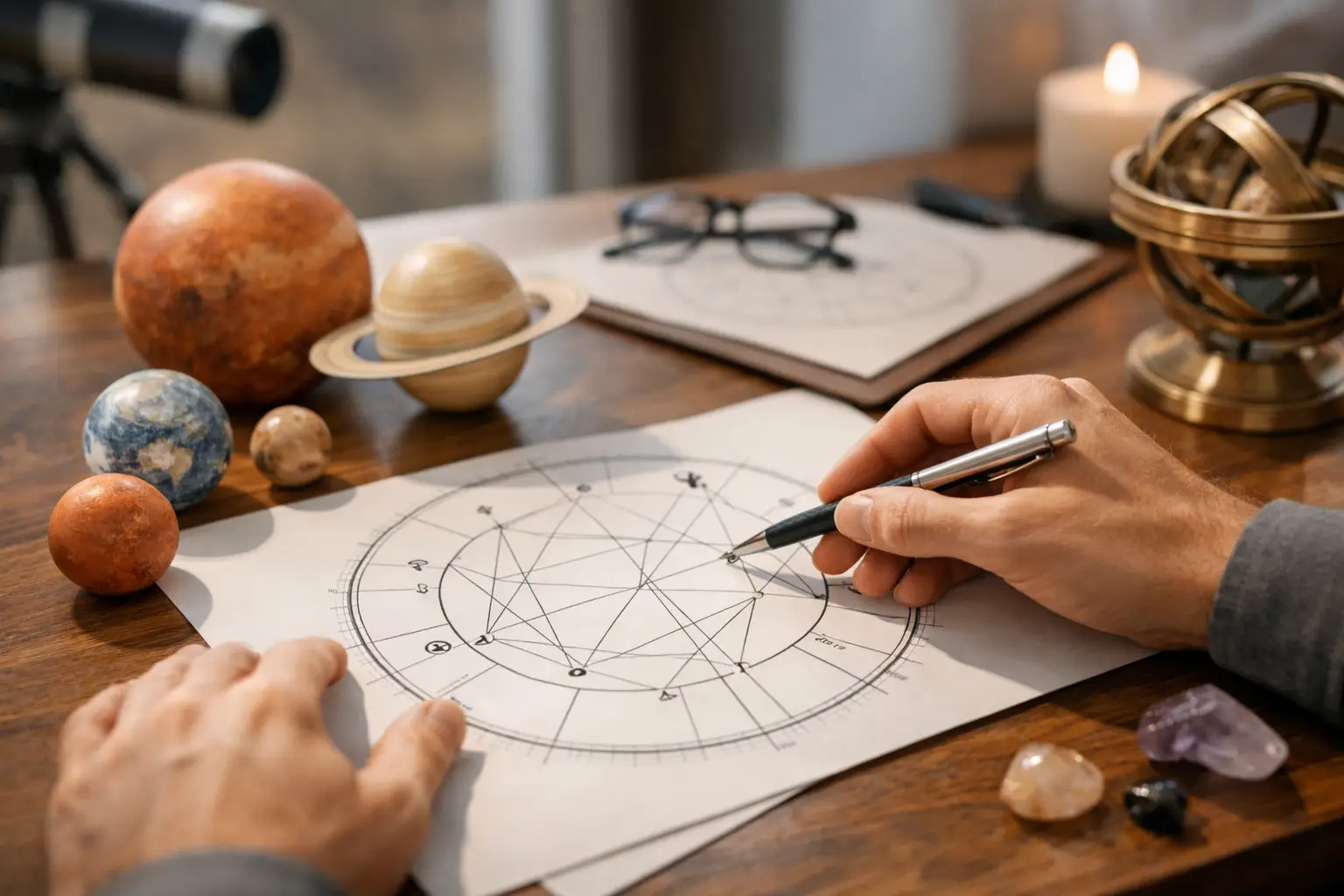
Planetary Aspects in a Birth Chart: A Clear Guide to Their Meaning
Your birth chart may show a confident Leo Sun, a tender Pisces Moon, or a practical Virgo rising, but those placements reveal only part of your story. Planetary aspects in a birth chart show how the different parts of you speak to one another. They describe the inner conversations behind your choices: why love can feel both exciting and vulnerable, why ambition may come with pressure, or why your intuition becomes especially strong in uncertain moments.
Think of the planets as individual voices and aspects as the relationships between them. Some connections flow easily. Others create friction that asks you to grow. Neither is better than the other. Your chart is not a report card. It is a living map of your gifts, needs, patterns, and the celestial wisdom available to you as you move through life with greater clarity.
What planetary aspects in a birth chart reveal
An aspect is the angle formed between two planets at the moment of your birth. Astrology reads that angle as a particular kind of energetic exchange. The Sun represents identity and purpose, the Moon reflects emotional needs, Mercury shapes communication, Venus describes connection and values, and Mars speaks to desire and action. When these planets form aspects, their meanings blend, challenge, support, or intensify one another.
For example, Venus connected to Mars often brings a strong instinct for affection, attraction, and creative expression. Venus connected to Saturn can make you deeply loyal in love while also asking you to soften fears around rejection or emotional risk. The aspect does not dictate every relationship you will have. It highlights emotional terrain you may recognize and learn to work with.
The signs tell you how a planet expresses itself. The houses show where that energy tends to appear in daily life. Aspects explain how planetary energies cooperate or create tension. Reading all three together makes a chart feel far more personal.
The five major aspects to know
Conjunction: when energies become one
A conjunction occurs when two planets sit very close together, usually in the same sign. Their energies fuse so tightly that they can be difficult to separate. A Mercury-Venus conjunction may give you a charming, thoughtful communication style and a gift for saying what others feel. A Moon-Pluto conjunction can bring emotional depth, powerful instincts, and a need for honesty beneath the surface.
Conjunctions are concentrated. They can feel like a central theme in your identity, especially when the Sun, Moon, or rising-chart ruler is involved. The key is to give both planets a healthy outlet. A Mars-Saturn conjunction, for instance, can feel like driving with one foot on the gas and one on the brake. With patience, it can become remarkable discipline and endurance.
Sextile: an open door
A sextile connects planets about 60 degrees apart. It often points to a natural opportunity, talent, or helpful opening. These aspects tend to be gentle, which means they sometimes need your participation before they become visible in your life.
A Mercury-Jupiter sextile can support learning, big-picture thinking, and encouraging conversations. A Venus-Uranus sextile may bring ease around trying new social circles or expressing your style more freely. This energy responds well when you say yes to a class, an invitation, a creative idea, or a conversation that expands your perspective.
Square: the growth edge
A square forms when planets are roughly 90 degrees apart. It creates pressure, contrast, and movement. Squares can be uncomfortable because they expose where two needs seem to pull you in different directions. Yet they are also some of the strongest sources of motivation in a chart.
Consider a Moon-Mars square. You may feel emotions quickly and react before you have had time to name what hurts. That can create conflict, but it also gives you fierce protective instincts and the courage to address what is not working. The practice is not to silence Mars or dismiss the Moon. It is to pause long enough for feeling and action to work together.
Squares often become easier to carry as you gain self-awareness. They ask for conscious choices rather than automatic reactions. In this way, a challenging aspect can become a major source of personal growth.
Trine: natural flow
A trine links planets about 120 degrees apart, usually in signs of the same element. It reflects ease, affinity, and abilities that can feel familiar to you. A Sun-Jupiter trine can support optimism, generosity, and confidence in your path. A Moon-Neptune trine may deepen empathy, imagination, and spiritual sensitivity.
Because trines feel natural, they can become background music. You may underestimate a gift because it comes easily. Notice what people often seek your help with, what restores your confidence, or where you feel most able to trust yourself. Those are clues to the resources a trine offers.
Opposition: finding balance through relationship
An opposition occurs when planets face one another from opposite sides of the chart. It can bring a push-pull experience, often expressed through close relationships, work dynamics, or the tension between private needs and public roles. Oppositions do not mean conflict is inevitable. They invite balance and perspective.
With Venus opposite Saturn, you may long for meaningful commitment while also being cautious about opening your heart. With Mercury opposite Uranus, your thoughts may move between familiar logic and sudden flashes of insight. The work is to avoid choosing one planet while rejecting the other. Both belong in your life.
How to read aspects without getting overwhelmed
Start with your Sun, Moon, Mercury, Venus, and Mars. These personal planets often speak most directly to identity, emotions, communication, relationships, and everyday drive. Look first for aspects involving the Sun or Moon, then notice connections to Venus and Mars if love, confidence, creative energy, or boundaries are on your mind. For a broader approach to interpreting your chart, explore this personal guide to birth chart interpretation.
Next, pay attention to repeated patterns. If several planets form squares, your chart may carry a strong instinct to act, improve, and meet challenges directly. If trines and sextiles appear often, you may have supportive inner resources but benefit from setting clear goals so your gifts do not go unused. A single aspect matters, but a pattern tells a fuller story.
Also consider the houses. A Venus-Mars trine may feel different in the fifth house of romance and creativity than in the tenth house of career and public direction. In the fifth, it can support playful self-expression and magnetic dating energy. In the tenth, it may help you bring charm, initiative, and artistic vision to your professional life.
You will also see the word orb in chart interpretations. An orb is the amount of space allowed around an exact aspect. Tighter aspects are generally felt more strongly, especially when they involve the Sun, Moon, or chart ruler. Still, do not dismiss an aspect simply because it is wider. Its importance depends on the planets involved and the overall pattern of your chart.
Working with challenging aspects in real life
A difficult aspect is not a cosmic punishment. It is an area where awareness changes everything. When you identify a square or opposition, ask yourself what each planet needs. If Mercury squares Neptune, you may need both clear facts and room for imagination. If Venus squares Pluto, you may need both intimacy and steady boundaries. Naming both sides helps you move beyond all-or-nothing choices.
Journaling can be especially useful here. After an emotional moment, write down which planetary themes were active. Was it a Moon need for safety? A Mars need to act? A Saturn fear of getting it wrong? Over time, you begin to recognize your inner timing before a familiar pattern takes over.
Your aspects are not here to make you perfect. They are here to help you understand why certain lessons return, what strengths you can rely on, and where a more compassionate response can change the direction of your day. Let your chart be a companion rather than a verdict. Each time you meet one of its tensions with honesty, you create more space for the person you are becoming.