
7 Best Tarot Spreads for Beginners to Try Today
Discover seven beginner-friendly tarot spreads for daily guidance, relationships, decisions, release, and intention-setting. Learn how to ask clearer questions and read the cards with confidence.
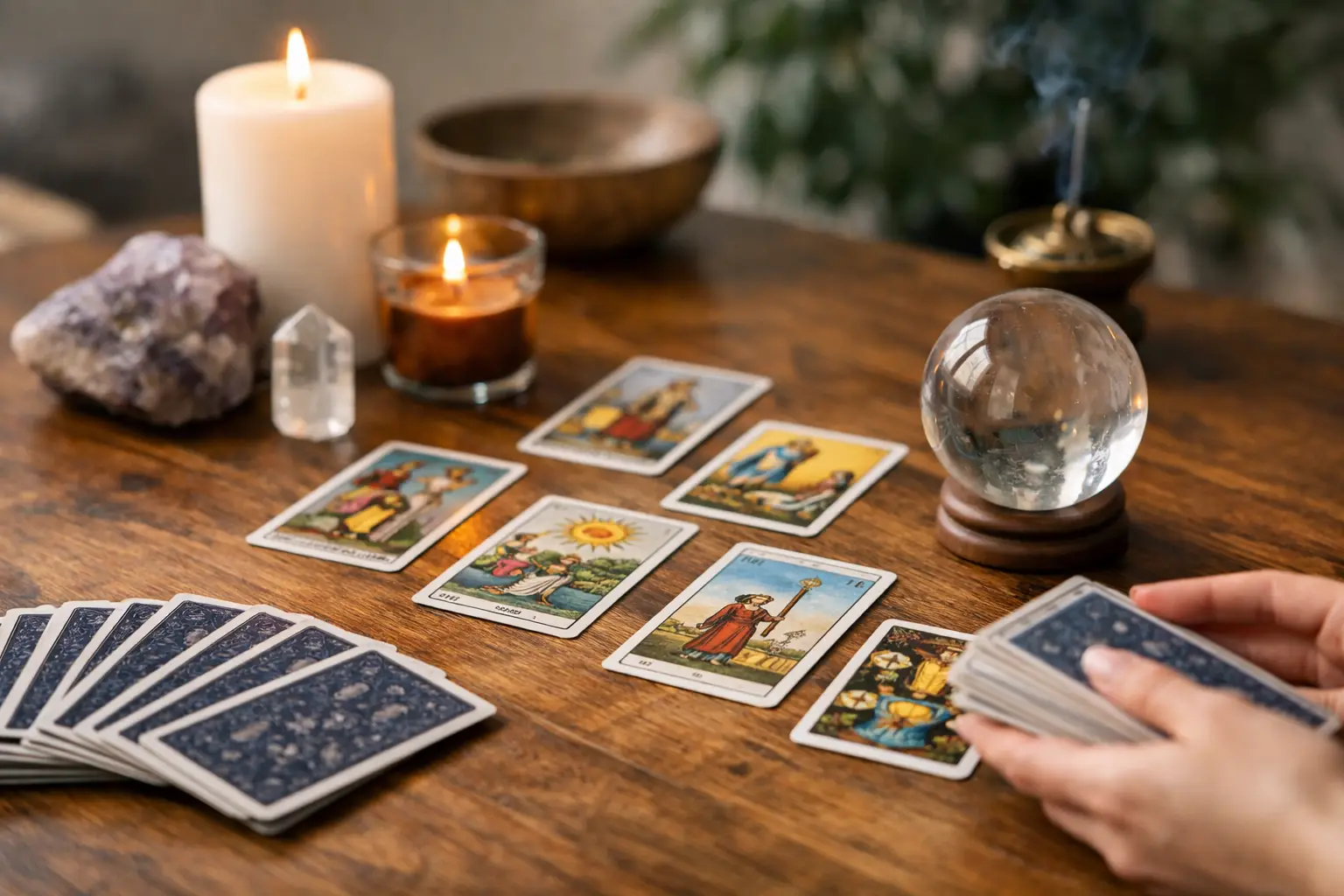
A tarot deck can feel loud when all 78 cards are waiting for you at once. You may pull the Five of Cups while thinking about a relationship, then notice the Ace of Pentacles at the bottom of the deck and wonder what you are meant to do with both messages. The best tarot spreads for beginners create a gentle container for that uncertainty. They give each card a purpose, so your reading becomes a conversation with your inner wisdom rather than a scramble to memorize meanings.
You do not need an elaborate ritual, a perfectly quiet room, or instant intuition to begin. You need a sincere question, a few uninterrupted minutes, and a willingness to notice what rises to the surface. Tarot is especially helpful when life feels emotionally layered, whether you want clarity about love, work, identity, or the next step without forcing yourself into an answer before you are ready.
Start With a Question That Has Room to Breathe
Before choosing a spread, pause with the situation in front of you. A useful tarot question invites guidance rather than demanding a fixed prediction. Instead of asking, “Will I get the job?” try, “What energy should I bring to my job search?” Instead of, “Does this person love me?” ask, “What do I need to understand about this connection?”
This shift matters. Tarot shows the emotional currents, patterns, choices, and possibilities surrounding a moment. It can reveal what you have been avoiding, what is ready to grow, and where your energy is best placed. A spread gives those insights a clear place to land.
As you shuffle, hold your question in mind. Cut the deck if that feels natural, then draw the number of cards the spread calls for. Read each card through its position first. The Tower in a position called “what needs to change” carries a different message than the Tower in a position called “your hidden strength.”
The Best Tarot Spreads for Beginners
Start small. A one- or three-card reading will teach you far more about card relationships than a complicated ten-card layout that leaves you overwhelmed. These spreads are simple enough to return to often, yet meaningful enough to support real reflection. For more foundational guidance, explore tarot card meanings for beginners as you build your relationship with the deck.
1. The One-Card Daily Compass
Draw one card in the morning and ask, “What energy is asking for my attention today?” You can also pull a card in the evening with the question, “What was I meant to understand from today?”
This is not a small practice simply because it uses one card. A one-card tarot reading for today builds a living relationship with your deck. If you draw the Hermit, notice where solitude, reflection, or a need for quieter boundaries shows up. If you draw the Page of Wands, watch for a spark of curiosity that deserves your attention. Keep a few notes in a journal, then revisit them at the end of the week. Over time, the cards become less like definitions in a guidebook and more like familiar symbols in your own inner language.
2. The Past, Present, and Next Step Spread
Draw three cards from left to right:
- The influence from the past
- What is active now
- The next supportive step
This classic spread is a beautiful choice when you feel caught between where you have been and where you hope to go. The third card is intentionally framed as a next step rather than a final outcome. Your future is not a locked door. It is shaped by the awareness and choices you bring to the path.
Imagine you are recovering from burnout and pull the Ten of Wands, Four of Swords, and Six of Pentacles. The story is clear: you have carried too much, your nervous system needs rest, and more balanced support or exchange is possible. The reading does not ask you to solve your whole life by Tuesday. It points you toward the energy that can begin restoring balance.
3. The Situation, Challenge, and Guidance Spread
When you need practical clarity, draw three cards for:
- What is happening beneath the surface
- What is making this difficult
- Guidance for moving forward
Use this spread for work decisions, friendship tension, creative blocks, or periods when your emotions seem tangled. It helps separate the core issue from the fear or resistance around it.
Say you are considering a career change and draw the Eight of Cups, Two of Swords, and Queen of Pentacles. The Eight of Cups may show that your current path no longer feeds your spirit. The Two of Swords names the indecision that has kept you still. The Queen of Pentacles advises a grounded approach: honor your needs, make a practical plan, and build security while you move toward work that feels more nourishing.
4. The Love Connection Spread
For a relationship, pull four cards in a square or line:
- Your energy in the connection
- Their energy in the connection
- The energy between you
- What you need to know now
This spread is not meant to override another person’s privacy or free will. Its purpose is to help you understand the dynamic you are participating in. It can be especially clarifying when you are stuck analyzing every text, mixed signal, or moment of distance.
If the cards show the Moon in your position, the King of Cups in theirs, the Two of Pentacles between you, and Justice as guidance, the message may be that uncertainty is amplifying your emotions while the connection requires steadier communication and honest standards. Rather than chasing certainty, ask what fairness, clarity, and emotional self-respect look like here.
5. The Decision Crossroads Spread
When two paths are calling you, draw four cards:
- What Path A is teaching you
- What Path B is teaching you
- What you most need to consider before deciding
- The wisdom you can carry into either path
The purpose is not to make tarot choose for you. It is to reveal the deeper values beneath your choice. One option may offer growth through boldness, while the other offers healing through stability. Neither is automatically better. Your current season matters.
For example, the Chariot on one path could point to ambition, movement, and self-direction. The Four of Swords on the other may point to recovery and integration. If you have spent months pushing through exhaustion, rest may be the courageous choice. If you have been waiting out of fear, the Chariot may be asking you to take the reins.
6. The Full-Moon Release Spread
The full moon brings illumination. It often heightens emotions, reveals what has been building, and makes it easier to see what no longer belongs in your life. During a full moon, draw three cards:
- What is coming into clear view
- What you are ready to release
- What can support your healing
This spread pairs well with a simple ritual. After your reading, write down the pattern, belief, or attachment you are ready to loosen. You do not have to erase it overnight. Releasing can mean naming it with honesty and choosing not to let it direct every decision. You can deepen this practice with a full-moon release ritual.
7. The New-Moon Intention Spread
A new moon begins a fresh lunar cycle. Its energy supports intention, quiet beginnings, and planting seeds before you can see the full result. Draw three cards:
- Where your energy wants to grow
- What needs your commitment
- One action to take this cycle
Keep the final position specific. If the card is the Page of Pentacles, your action may be researching a class, opening a savings account, or setting aside time to practice a new skill. If it is Strength, the action may be having one calm, honest conversation instead of silencing your needs. Celestial wisdom becomes most powerful when it reaches your calendar, your boundaries, and your daily choices. For a grounded way to work with this lunar energy, try a new-moon intention-setting ritual.
How to Read Without Overthinking Every Card
Beginners often believe they must know every traditional meaning before trusting a reading. Study is valuable, but tarot also speaks through color, posture, symbols, and the feeling a card creates in your body. Notice what catches your eye first. Is a figure walking away? Is the sky clear or stormy? Does the card feel like expansion, caution, grief, relief, or movement?
Then bring in the card’s established meaning and the spread position. Let these layers work together. The Three of Swords may point to pain, truth, or a necessary emotional acknowledgment. It does not always mean betrayal. The Death card often speaks of endings and transformation, not literal loss. Context is your guide.
If a reading feels confusing, do not pull five clarifier cards immediately. Sit with the original spread. Write what you know, what you feel, and what you are resisting. A single clarifying card can help if you are truly stuck, but too many cards can blur a message that was already asking to be heard.
Let Your Practice Grow at Its Own Pace
Choose one spread and use it for a week before moving to another. Repetition shows you how the cards change their expression across different days and questions. It also creates a steady moment of self-connection, especially when life feels uncertain or emotionally full.
Your tarot practice does not need to be perfect to be meaningful. Meet the cards with honesty, make space for what they illuminate, and let each reading offer guidance for your cosmic journey, one clear and compassionate step at a time.