
Astrology Versus Tarot: Which One Can Answer Life’s Big Questions?
Astrology reveals the larger patterns and timing shaping your life, while tarot brings the present moment into focus. Learn how to choose the right practice—or let both guide you through change.
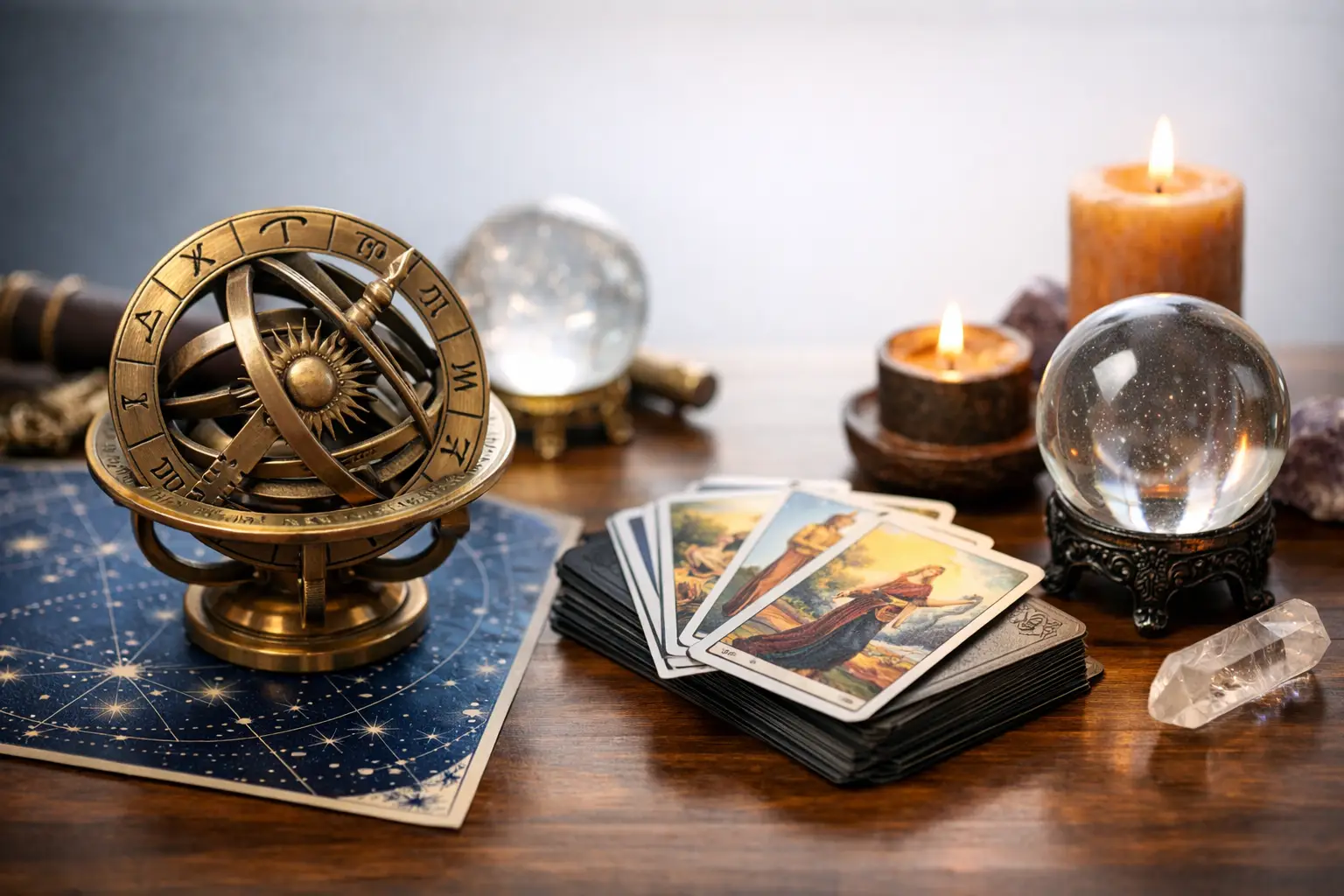
A question about a relationship can feel urgent at 11 p.m. You may want to understand what your partner is feeling, why a familiar conflict keeps returning, or whether it is time to speak honestly. This is where astrology versus tarot becomes more than a philosophical comparison. Both can offer meaningful guidance, but they illuminate different parts of your experience.
Astrology helps you understand the larger pattern: your lasting needs, your natural rhythms, and the planetary weather shaping a chapter of life. Tarot brings you into direct conversation with the choice, emotion, or tension in front of you now. Neither practice is more powerful than the other. The most supportive tool depends on the question your heart is asking.
Astrology versus tarot: the essential difference
Astrology reads the language of the sky through time. Your birth chart is a map of the celestial placements at the moment you were born. It includes your Sun sign, Moon sign, rising sign, planets, houses, and the relationships between them. Together, these symbols reveal themes around identity, emotional needs, communication, love, work, purpose, and growth.
A horoscope follows current planetary movements, known as transits. If Venus is moving through your relationship sector, connection, attraction, values, and reciprocity may come forward. If Saturn is applying pressure to a personal planet, you may be asked to build stronger boundaries, take responsibility, or face a truth that has been easy to postpone.
Tarot works differently. A tarot deck contains 78 cards, each carrying a symbolic scene and energetic lesson. The cards you pull reflect the living energy around a situation and the inner response it asks of you. Where astrology can show that you are moving through a season of career restructuring, tarot can reveal what is making the decision difficult: fear of disappointing others, exhaustion, or a desire that is ready to be honored.
Astrology gives context. Tarot gives immediate perspective. Astrology can explain why a pattern feels especially active, while tarot can help you meet that pattern with greater honesty today.
When astrology is the clearer choice
Turn to astrology when you want to understand yourself at a deeper, long-range level. A birth chart is especially helpful when a question keeps repeating: Why do I choose emotionally unavailable partners? Why do I struggle to trust my own voice at work? Why does change feel exciting and unsettling at the same time?
Your chart does not reduce you to a label. It shows the core energies you are learning to work with. Someone with a fiery Aries Sun may be wired to initiate and act boldly, while a sensitive Cancer Moon may need reassurance and emotional safety before that boldness can feel sustainable. Knowing both placements can soften the pressure to be only one thing.
Astrology is also valuable when timing matters. Planetary transits can bring recognizable themes to the surface. A Mercury retrograde period may ask you to revisit a conversation, clarify a contract, or slow down before assuming you have all the facts. A New Moon can support intention-setting in the life area connected with its sign and house. A Full Moon tends to reveal what has been building, making emotions, needs, or results harder to ignore.
This does not mean every transit dictates a single outcome. Celestial influences describe the quality of time, not a rigid script. If a major transit activates your career sector, you might receive a new opportunity, recognize that a role no longer fits, or begin the inner work that prepares you for a later shift. Astrology helps you recognize the invitation so you can respond consciously.
Use astrology for patterns and timing
Choose astrology when you want insight into your foundational nature, a recurring life lesson, relationship compatibility, or the broader rhythm of the coming weeks and months. It is the tool that helps you see the landscape before choosing your next step.
Astrology can be especially grounding during uncertainty. Instead of asking why everything feels unsettled, you can look at the transit moving through your chart and understand what part of life is being reshaped. That awareness does not erase discomfort, but it gives the change a container.
When tarot is the clearer choice
Tarot is often the better companion when the question is immediate, emotional, and specific. You may already know that you are in a period of change. What you need now is clarity about how you are participating in it.
Imagine that you are deciding whether to stay in a job that has become draining. Your birth chart and current transits may show a major season of professional reassessment. A tarot reading can bring the present crossroads into focus. The Eight of Cups may point to the emotional cost of staying where your spirit has outgrown the role. The Two of Pentacles may ask you to consider practical balance before making a leap. The Queen of Wands may remind you that confidence grows when you make room for your own vision.
A tarot card is not a verdict. It is a symbol with a message that becomes meaningful in the context of your question. Tarot can reveal guidance without reducing your future to a fixed prediction. The Tower does not mean your life is doomed to fall apart. It often appears when an unstable structure, false assumption, or avoided truth needs to be confronted. The card can be startling, but its deeper guidance is about clearing space for what is more real.
Likewise, the Death card rarely speaks of literal endings. It brings transformation, release, and the closing of a chapter that cannot move forward in its current form. Tarot teaches you to notice endings not only as losses, but as thresholds.
Use tarot for the next honest step
Choose tarot when you need to name the energy surrounding a decision, understand a difficult feeling, or reconnect with your intuition. It is well suited to questions such as, “What am I not seeing in this situation?” “What needs my attention in this relationship?” or “How can I support myself through this transition?”
Tarot works best when you ask open, empowering questions. Rather than asking whether someone will call, ask what you need to understand about the connection. Instead of asking whether you will get the job, ask what will help you show up with confidence and discern whether the role aligns with your values. This approach keeps your agency at the center of the reading.
How astrology and tarot work together
The richest guidance often comes from letting these practices speak to each other. Astrology identifies the chapter. Tarot reveals the conversation happening inside that chapter.
Say you are experiencing a Venus transit that brings love, self-worth, and financial values into focus. You might feel drawn to examine how much energy you give in relationships, what kind of affection truly nourishes you, or whether your spending reflects what matters most. A tarot spread can help you explore the details: what you are ready to receive, what pattern needs healing, and what boundary would create more balance.
Or perhaps Mars is activating your communication zone, bringing courage and friction to the way you speak. Tarot can help you prepare for a conversation by showing where defensiveness is likely to arise and what truth deserves a calmer voice. Astrology tells you the theme is active. Tarot helps you work with it in a personal, practical way.
You do not need a complicated ritual to begin. You might check your daily horoscope in the morning, then pull one card with the question, “How can I work with this energy wisely?” A one-card tarot reading for today can give you a simple point of focus. Keep a journal nearby. Over time, you will begin to notice how planetary cycles and card symbols echo your lived experience.
Choosing the right tool for your question
If you are new to both practices, begin with the kind of clarity you need most. Reach for astrology when you want to understand your identity, a repeating theme, or the timing of a larger life season. Reach for tarot when a particular choice, conversation, or emotional knot needs your attention now.
There are times when astrology may feel too broad. Knowing that a transit is transforming your relationship life can be validating, but it may not answer what you need to say after an argument. That is a beautiful moment for tarot. At other times, tarot may show a recurring card such as the Five of Pentacles or the Nine of Swords, and astrology can help you understand the deeper cycle that is making insecurity or worry especially tender.
Neither practice asks you to surrender your judgment. Their purpose is to help you listen more closely to yourself, recognize the energies moving through your life, and make choices with greater clarity. The chart offers celestial wisdom about your path. The cards hold up a mirror to the present moment.
The next time life places you at a crossroads, pause before searching for a quick answer. Ask whether you need to understand the season you are in or the step that wants to be taken within it. The sky and the cards can meet you there, offering not a fixed future, but a steadier relationship with your own inner knowing.