
Zodiac Elements: Fire, Earth, Air, and Water Signs
Learn the four astrology elements—fire, earth, air, and water—the signs in each group, and how elemental balance shapes a birth chart.
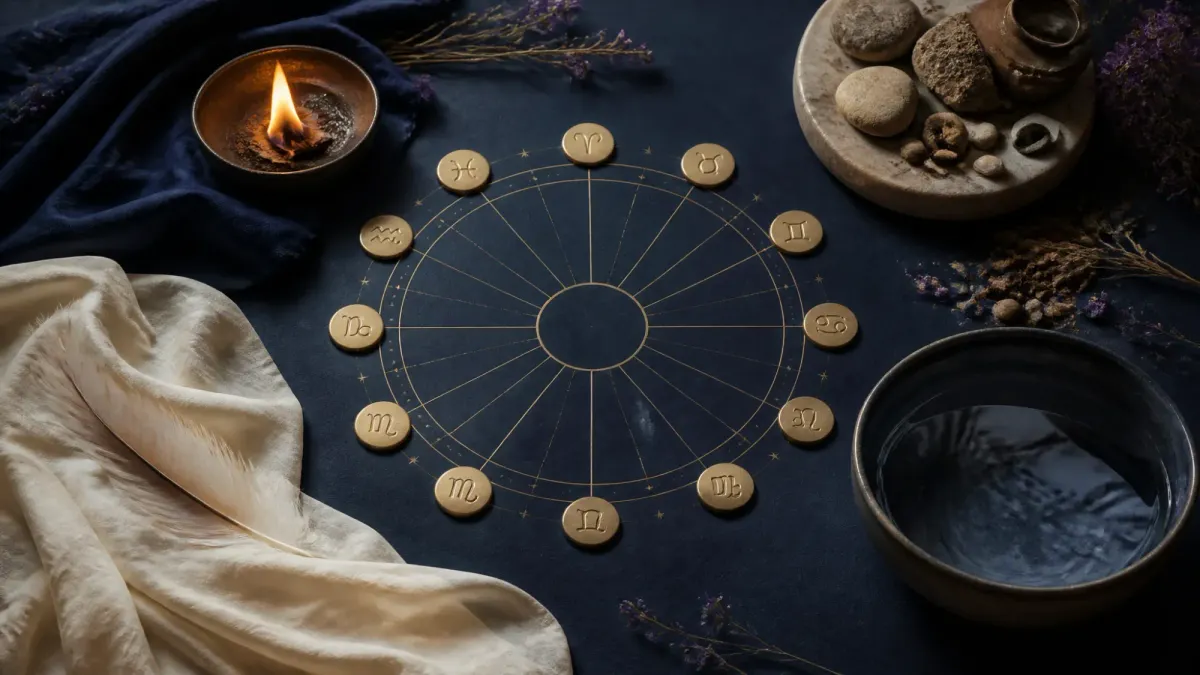
The four zodiac elements—fire, earth, air, and water—offer one of astrology’s simplest ways to understand how the twelve signs approach life. Each element describes a broad style of motivation, perception, communication, and response. Learning the elements can help you see why some signs act quickly, others seek stability, some lead with ideas, and others process experience through feeling.
Every element contains three zodiac signs: one cardinal, one fixed, and one mutable. That shared element creates common ground, while the different modalities explain why signs in the same group do not behave identically. A complete birth chart usually combines several elemental styles, so no person is defined by their Sun sign alone.
The four zodiac elements at a glance

- Fire signs: Aries, Leo, and Sagittarius — action, inspiration, confidence, and creative expression.
- Earth signs: Taurus, Virgo, and Capricorn — practicality, stability, patience, and tangible results.
- Air signs: Gemini, Libra, and Aquarius — ideas, communication, perspective, and social connection.
- Water signs: Cancer, Scorpio, and Pisces — emotion, intuition, imagination, and sensitivity.
These keywords are starting points, not fixed personality labels. The meaning of an element changes according to the planet, house, sign, and aspects involved.
What do the four elements mean in astrology?
In astrology, an element describes the basic quality through which a sign engages with the world. Fire tends to energize, earth stabilizes, air connects, and water attunes. None is better than another. Each brings useful capacities and recognizable challenges, and a healthy chart interpretation makes room for the full range.
Why No Zodiac Sign Is Inherently Negative
It is a common misconception that certain zodiac signs—or the elements themselves—are “negative” or “bad.” None of the signs is fundamentally negative. Each element, and every sign within it, represents a distinct way of engaging with life’s challenges and joys. Rather than labeling signs as good or bad, it is more useful to see them as energetic patterns with their own strengths and potential pitfalls.
Fire, earth, air, and water each offer essential qualities that everyone draws upon, regardless of their chart. The energy itself is neutral; how it is expressed can move toward balance or excess. Fire’s drive can fuel invention or spill into impatience. Earth’s pragmatism can anchor dreams or harden into stubbornness. Air can inspire brilliant conversation or scatter attention. Water can nurture connection or become overwhelming when boundaries are unclear.
Every zodiac sign reflects a spectrum of potential, including both gifts and challenges. Astrology is not about painting anyone with a negative brush. It is a framework for understanding the fuller palette of human experience and using that awareness more consciously.
Fire signs: Aries, Leo, and Sagittarius
Fire signs are associated with movement, courage, enthusiasm, creativity, and the desire to act. Fire energy often learns through direct experience: it wants to begin, explore, express, or inspire. When supported, it can bring warmth, momentum, optimism, and a willingness to take meaningful risks.
At its best, fire energy helps us recover from defeat or disappointment. Its resilience is active: it looks for the next opening, restores enthusiasm, and encourages another attempt. The same spark fuels imagination, self-expression, and the appetite to create, explore, and celebrate what makes life meaningful.
Fire still needs to be tended carefully. When overextended, its speed can become impatience, impulsiveness, burnout, or frustration with slower processes. Unchecked intensity may overwhelm a situation, while well-supported fire offers renewal, creative courage, and a contagious sense of possibility.
Aries expresses cardinal fire by initiating. Leo expresses fixed fire through sustained creative identity and loyalty. Sagittarius expresses mutable fire through exploration, learning, and expanding horizons.
Earth signs: Taurus, Virgo, and Capricorn
Earth signs focus on what is concrete, useful, sustainable, and embodied. Earth energy notices resources, routines, responsibilities, and the practical steps required to make an idea real. It can support patience, craftsmanship, dependability, and a strong relationship with the physical world.
When earth becomes overemphasized, caution can turn into rigidity, excessive control, or resistance to unfamiliar possibilities. Taurus is fixed earth, preserving what has value. Virgo is mutable earth, refining systems and responding to practical needs. Capricorn is cardinal earth, organizing effort toward long-term goals.
Air signs: Gemini, Libra, and Aquarius
Air signs engage through language, ideas, comparison, and social exchange. Air energy seeks perspective. It names patterns, asks questions, shares information, and considers how people or concepts relate to one another. At its best, air can create curiosity, fairness, inventiveness, and connection.
Its challenges can include overthinking, indecision, detachment, or living mainly in theory. Gemini is mutable air, gathering and adapting information. Libra is cardinal air, initiating dialogue and relationship. Aquarius is fixed air, sustaining a vision, principle, or way of thinking.
Water signs: Cancer, Scorpio, and Pisces
Water signs are associated with feeling, memory, intuition, imagination, and emotional bonds. Water energy tends to perceive atmosphere and subtext. It can deepen empathy, creativity, care, and the capacity to sit with experiences that cannot be solved through logic alone.
When water lacks support or boundaries, sensitivity can become overwhelm, secrecy, withdrawal, or emotional enmeshment. Cancer is cardinal water, initiating care and protection. Scorpio is fixed water, concentrating emotional depth and commitment. Pisces is mutable water, adapting through imagination, compassion, and surrender.
How elements and modalities work together
Each zodiac sign combines one element with one modality. The element describes the sign’s basic style; the modality describes how that energy moves.
- Cardinal signs initiate: Aries begins through fire, Cancer through water, Libra through air, and Capricorn through earth.
- Fixed signs sustain: Taurus holds earth, Leo holds fire, Scorpio holds water, and Aquarius holds air.
- Mutable signs adapt: Gemini changes through air, Virgo through earth, Sagittarius through fire, and Pisces through water.
This pairing explains why two signs can share an element yet express it differently. Leo and Sagittarius are both fire signs, for example, but fixed Leo may concentrate creative energy while mutable Sagittarius distributes it through movement, discovery, and changing experience.
How to read elemental balance in a birth chart

To explore elemental balance, start with the Sun, Moon, Rising sign, Mercury, Venus, and Mars. Then look at the rest of the planets and the chart ruler. A cluster of placements in one element may describe a familiar mode of operating, while a less represented element may point to a perspective that develops more consciously.
- Begin with the personal planets. The Sun and Moon describe central identity and emotional needs, while Mercury, Venus, and Mars add mental, relational, and motivational styles.
- Include the Rising sign and chart ruler. These can strongly shape how a person approaches life, even when their element is not dominant by planet count.
- Notice repetition, not just totals. Several planets in one sign, house, or connected aspect pattern may matter more than a simple element tally.
- Read the whole chart. Houses, aspects, and lived experience can express elemental themes in ways that a checklist cannot capture.
For a structured introduction to these chart components, continue with Astrology for Beginners.
What does a dominant or missing element mean?
A dominant element can describe an approach that feels natural and readily available. Strong fire might move toward action; strong earth toward practical construction; strong air toward analysis and exchange; strong water toward emotional and intuitive processing. Dominance does not guarantee skill. A familiar element can still become unbalanced or require maturity.
A missing or underrepresented element does not mean a person lacks an essential human quality. Someone with little air can still be an excellent communicator, and someone with little water can still be deeply caring. Other chart factors, relationships, work, culture, and experience can develop similar capacities. Treat a less represented element as an invitation to curiosity, not a flaw.
Do zodiac elements determine compatibility?
Elemental relationships can offer a useful first impression, but they do not determine whether two people are compatible. Fire and air may encourage movement and ideas; earth and water may support growth and security. Fire can warm earth or feel constrained by it, while air can give water perspective or seem too detached. The expression depends on the people and the complete charts involved.
For relationship questions, consider the Moon, Venus, Mars, Rising signs, house overlays, and aspects rather than comparing Sun-sign elements alone. Compatibility is a conversation about patterns and needs, not a pass-or-fail score.
Using the elements for self-reflection
The zodiac elements are most useful when they open a practical question. You might reflect on which style comes easily, which one you avoid, and what balance would look like in the situation you are facing.
- Fire: What action, risk, or creative expression wants room?
- Earth: What practical step, boundary, or routine would create stability?
- Air: What needs to be named, discussed, compared, or reconsidered?
- Water: What feeling, intuition, or emotional bond needs acknowledgment?
You do not need to “become” another element. The aim is to widen your available responses and work with your chart more consciously.
Frequently asked questions about zodiac elements
Which zodiac signs are fire, earth, air, and water?
Aries, Leo, and Sagittarius are fire signs. Taurus, Virgo, and Capricorn are earth signs. Gemini, Libra, and Aquarius are air signs. Cancer, Scorpio, and Pisces are water signs.
Is your zodiac element based only on your Sun sign?
Your Sun sign has an element, but your birth chart includes many placements across the four elements. The Moon, Rising sign, personal planets, chart ruler, houses, and aspects add important context.
Can a birth chart have no planets in one element?
Yes. A chart can have few or no planets in an element. This does not mean the person is incapable of that element’s qualities. Other placements and life experience may carry or develop the same themes.
Are fire and water—or earth and air—always incompatible?
No. Different elements can challenge, complement, and teach one another. Relationship dynamics depend on full-chart patterns and real communication, not a single elemental pairing.
A grounded approach to the four elements
Astrology is a symbolic and reflective practice, not a scientific method of prediction. Use elemental interpretations as prompts for self-inquiry rather than fixed judgments. Astrology cannot replace medical, legal, financial, mental-health, or other professional advice.
Keep learning with Astrological Insights
Explore the astrology learning hub or follow the guided path in Astrology for Beginners to connect signs, planets, houses, and aspects.
Join the free weekly newsletter for one practical astrology note, one tarot reflection prompt, and the newest beginner guide.